
PARTICLE MODEL OF MATTER · CHAPTER 3 OF 10
Calculating and measuring density
Two objects can look similar but be made from very different materials. How could you use measurements to investigate them? Measure each object’s mass and volume, then calculate its density.
By the end, you’ll be able to…
- Use and rearrange the density equation.
- Choose consistent units and convert between common density units.
- Explain calculations where mass and volume change.
- Determine the density of regular solids, irregular solids and liquids.
- Identify measurement errors and explain how to improve a method.
From an idea to an equation
In Chapter 2, density described how much mass there is in each unit of volume. To calculate that amount, divide the total mass by the total volume. This lets us compare samples fairly, even when their sizes differ.
The equation
density = mass ÷ volume
ρ = m ÷ V
ρ= density in kilograms per cubic metre (kg/m³)
m=mass in kilograms (kg)
V=volume in cubic metres (m³)
☆ Density is usually expressed in kilograms per cubic metre (kg/m³). For smaller objects, we can also use grams and cubic centimetres, giving density in grams per cubic centimetre (g/cm³). We’ll use these units in the candle example below.
Finding mass or volume instead
The same relationship can find a missing mass or volume. Multiply density by volume to find mass. To find volume, divide mass by density. Write the rearranged equation before substituting the numbers, then include the correct unit in your answer.
To calculate density:
An acrylic phone stand has a mass of 0.12 kg and a volume of 0.0001 m³. Calculate its density.
ρ = m ÷ V
ρ = 0.12 ÷ 0.0001
ρ = 1200 kg/m³
To calculate mass:
An acrylic jewellery organiser has a density of 1200 kg/m³. The acrylic used to make it has a volume of 0.001 m³. Calculate its mass.
m = ρ × V
m = 1200 × 0.001
mass = 1.2 kg
To Calculate volume:
A silver pendant has a mass of 21 g and a density of 10.5 g/cm³. Calculate its volume.
V = m ÷ ρ
V = 21 ÷ 10.5
Volume = 2 cm³
Getting the units right
Volume units describe three dimensions. Because 1 m = 100 cm, a cube measuring 1 m on each edge contains 100 × 100 × 100 cubic centimetres. So 1 m³ = 1,000,000 cm³—not 100 cm³.
Mass
Volume
Liquid volume
1 litre = 1,000 cm³
Combining the mass and volume conversions gives 1 g/cm³ = 1,000 kg/m³. Multiply a density in g/cm³ by 1,000 to express it in kg/m³; divide by 1,000 to convert back.
Why does 2.7 g/cm³ equal 2700 kg/m³?
Convert both measurements into SI units: 54 g = 0.054 kg and 20 cm³ = 0.000020 m³.
ρ = m ÷ V
ρ = 0.054 ÷ 0.000020
ρ = 2700 kg/m³
This is the same density expressed using different units.
To convert from g/cm³ to kg/m³, multiply by
1000:
2.7 × 1000 = 2700 kg/m³.
What if the sample is cut in half?
Two smaller pieces have less mass than the whole sample—but does their density change? Use the equation to test the idea from Chapter 2.
Smaller piece. Lower density?
This solid bar is made from one uniform material. Imagine cutting it into two equal pieces without losing any material.
Each piece will be smaller and have less mass. But will its density be lower? Make a prediction before you cut.
Volume: 10 cm3 12 particle symbols
Same size and spacing
Volume: 10 cm3 12 particle symbols
Same size and spacing
Before cutting, the whole bar had a mass of 40 g and a volume of 20 cm3. Each piece now has half that mass and half that volume. Look at the particles inside each piece: has their spacing changed?
Each half of the bar has half the original mass and half the original volume, so its density stays the same. What happens if we halve the volume but keep the mass unchanged?
Same mass, half the volume
Compressing the trainer’s sealed air pocket reduces its volume. No gas escapes, so its mass stays the same. What happens to its density?
Same mass ÷ half the volume = twice the density.
Simplified illustration. The 12 dots represent gas particles; their size and number stay the same.
A regular solid: measure its dimensions
A cuboid’s volume is length × width × height. Measure each dimension in the same unit, then multiply all three—not just two. For a cylinder, measure its radius and height and use V = πr²h.
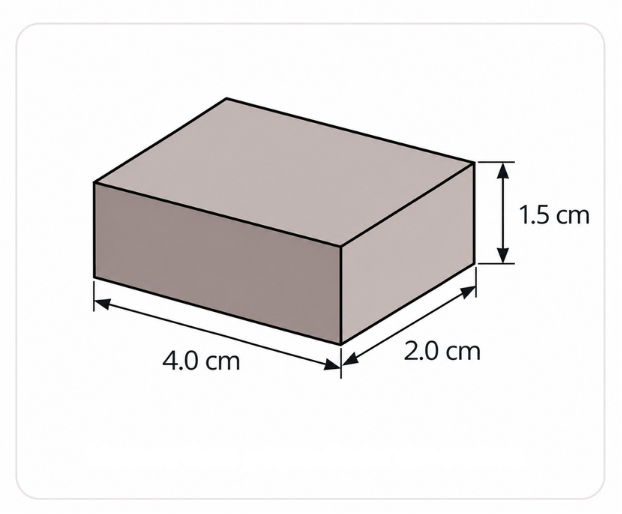
Method
- Measure the dry block’s mass on a balance.
- Measure its length, width and height using a suitable ruler or callipers.
- Calculate the volume, then divide mass by volume.
A ruler can suit a larger block; Vernier callipers are useful for smaller dimensions or diameters, and a micrometer can measure a thin sheet or small diameter. Check for zero error and use the instrument gently. Repeat measurements at different positions to check uniformity; calculate a mean where appropriate.
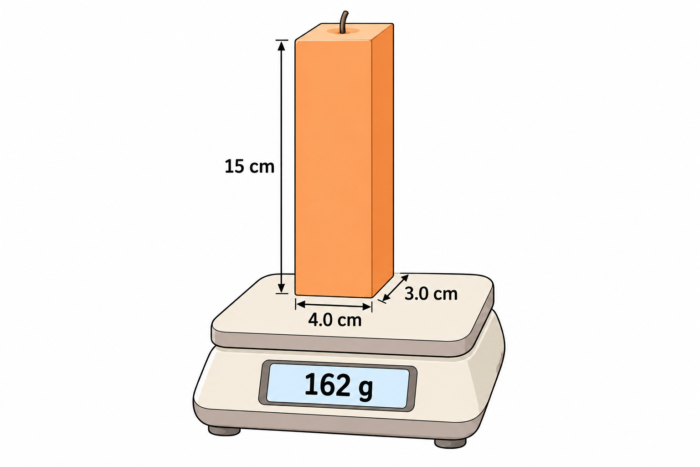
Worked example: calculating a candle’s density
A rectangular candle has a mass of 162 g. It measures 4.0 cm × 3.0 cm × 15 cm. Calculate its density, treating it as a solid cuboid and ignoring the wick.
1. Calculate its volume
Volume = length × width × height
Volume = 4.0 × 3.0 × 15
Volume = 180 cm³
2. Calculate its density
Density = mass ÷ volume
Density = 162 ÷ 180
Density = 0.90 g/cm³
Each cubic centimetre of wax has a mass of 0.90 g.
*Record the measured dimensions before calculating. A small thickness error can cause a large percentage error in volume, especially for a thin sample. More precise apparatus is useful only when it suits the measurement.
An irregular solid: use displacement
A small stone or metal charm has no simple set of dimensions that gives its volume. Instead, lower it into water. If it is fully submerged, the increase in water volume equals the volume of the solid.
Choose an object that sinks and does not dissolve, react with or absorb water. Measure its dry mass and record the initial water volume. Lower the object gently using a thin thread. Remove trapped air bubbles, then record the final reading with the object fully submerged.
Find the hidden volume
The dry stone has a mass of 54 g. The cylinder initially contains 40 cm³ of water. Predict what happens to the reading when the stone is submerged.
Use the increase in the reading—not the final reading alone—to find the stone’s volume.
Check the volume and density
Stone volume = 60 − 40 = 20 cm³
ρ = 54 ÷ 20 = 2.7 g/cm³
The 60 cm³ reading includes the original water and the submerged stone. It is not the stone’s volume.
What if the object will not fit?
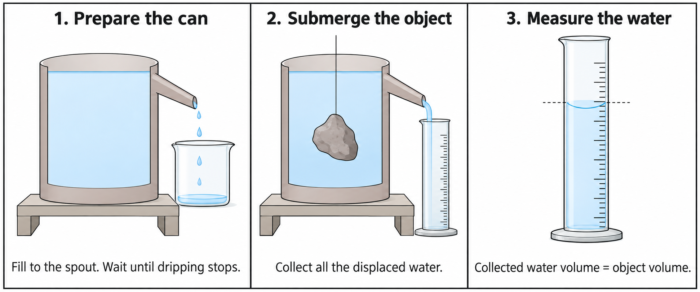
Use a displacement can. Fill it until water flows from the spout, then wait until dripping stops. Fully submerge the object and collect the displaced water in a measuring cylinder. The volume collected equals the object’s volume.
* The water surface curves slightly. Read the bottom of this curve, called the meniscus, at eye level.
A liquid: subtract the container’s mass
Measure the empty cylinder’s mass, add a known volume of liquid, then measure the filled mass. Subtract the empty mass to find the liquid’s mass and calculate density. Alternatively, zero (tare) the balance with the empty cylinder on it before adding liquid. Read the volume at eye level and keep the cylinder’s outside dry.
Weigh the liquid, not the cylinder
The empty measuring cylinder has a mass of 38.4 g. Add 50 cm³ of oil, then work out the oil’s mass and density.
The balance currently measures the empty cylinder. Predict how its reading will change when oil is added.
Find the oil’s mass first. Then use density = mass ÷ volume.
Oil mass = 78.4 − 38.4
Oil mass = 40.0 g
ρ = 40.0 ÷ 50
ρ = 0.80 g/cm³
Equivalent to 800 kg/m³
Using 78.4 g would include the cylinder’s mass, making the calculated density too high.
Why do small measurement errors matter?
Imagine a student accidentally records the final water level 1 cm³ too low when measuring two pieces of jewellery. How much does this mistake affect the calculated volume of each object?
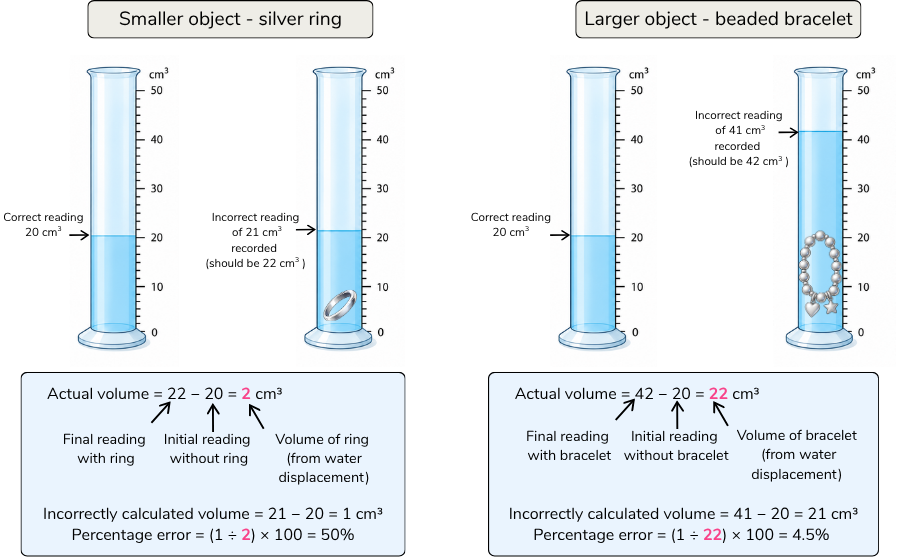
The same volume error has a greater percentage effect on the smaller object. Underestimating volume makes the calculated density too high.
INTERACTIVE QUICK CHECK
Choose one answer for each question. You’ll see feedback straight away.
A student measures a metal charm’s dry mass correctly, but air bubbles remain attached when it is submerged. Will the calculated density be too high, too low or unchanged? Explain your answer.
The calculated density is too low. The attached bubbles displace extra water, so the measured volume is larger than the charm’s actual volume.
The mass is correct, but dividing it by a volume that is too large gives a density that is too small.
For example, a 54 g charm with a volume of 20 cm³ has a density of 54 ÷ 20 = 2.7 g/cm³. If bubbles make the measured volume 22 cm³, the calculated density is 54 ÷ 22 ≈ 2.45 g/cm³.
Make sure the charm is fully submerged and remove attached air bubbles before taking the final reading.
Chapter summary
- Calculate density using ρ = m ÷ V. Rearrange to find mass using m = ρ × V or volume using V = m ÷ ρ.
- Use mass in kg and volume in m³ for density in kg/m³, or mass in g and volume in cm³ for density in g/cm³. 1 g/cm³ = 1000 kg/m³.
- Cutting a uniform material into smaller pieces reduces mass and volume in the same proportion, so its density stays the same. Compressing a sealed gas reduces its volume while its mass stays constant, increasing its density.
- For a regular solid, measure its mass and calculate its volume from its dimensions. A cuboid’s volume is length × width × height.
- For an irregular solid, find its volume from the water it displaces when fully submerged. In a measuring cylinder, subtract the initial reading from the final reading.
- For a liquid, measure its volume and subtract the empty container’s mass from the filled mass. Alternatively, zero the balance with the empty container on it before adding liquid.
- Measure solids’ masses while dry, avoid trapped air bubbles and read the bottom of the curved liquid surface at eye level. Use suitable measuring equipment and record units with every measurement.