
PARTICLE MODEL OF MATTER · CHAPTER 4 OF 10
Changes of state
A frozen smoothie melts, a wet hoodie dries and droplets appear on a cold drinks bottle. These changes look different, but each involves a substance changing state.
By the end, you’ll be able to…
- Name and describe the main changes of state.
- Explain how evaporation differs from boiling.
- Explain why mass is conserved during a change of state.
- Distinguish a change of state from a chemical change.
Same substance, different state
A change of state happens when a substance changes between solid, liquid and gas. Its particles remain the same: their arrangement and movement change. An ice lolly melts, a wet hoodie dries and a bathroom mirror mists over. These changes look different, but each involves a substance changing state.
A melting ice lolly
Solid ice changes into liquid water.
A drying hoodie
Liquid water evaporates into the surrounding air.
A misted bathroom mirror
Water vapour in the air condenses into tiny liquid droplets on the cooler mirror.
Naming the changes
Each direction has its own name. Heating can cause melting, boiling or sublimation. Cooling can cause freezing or condensation.
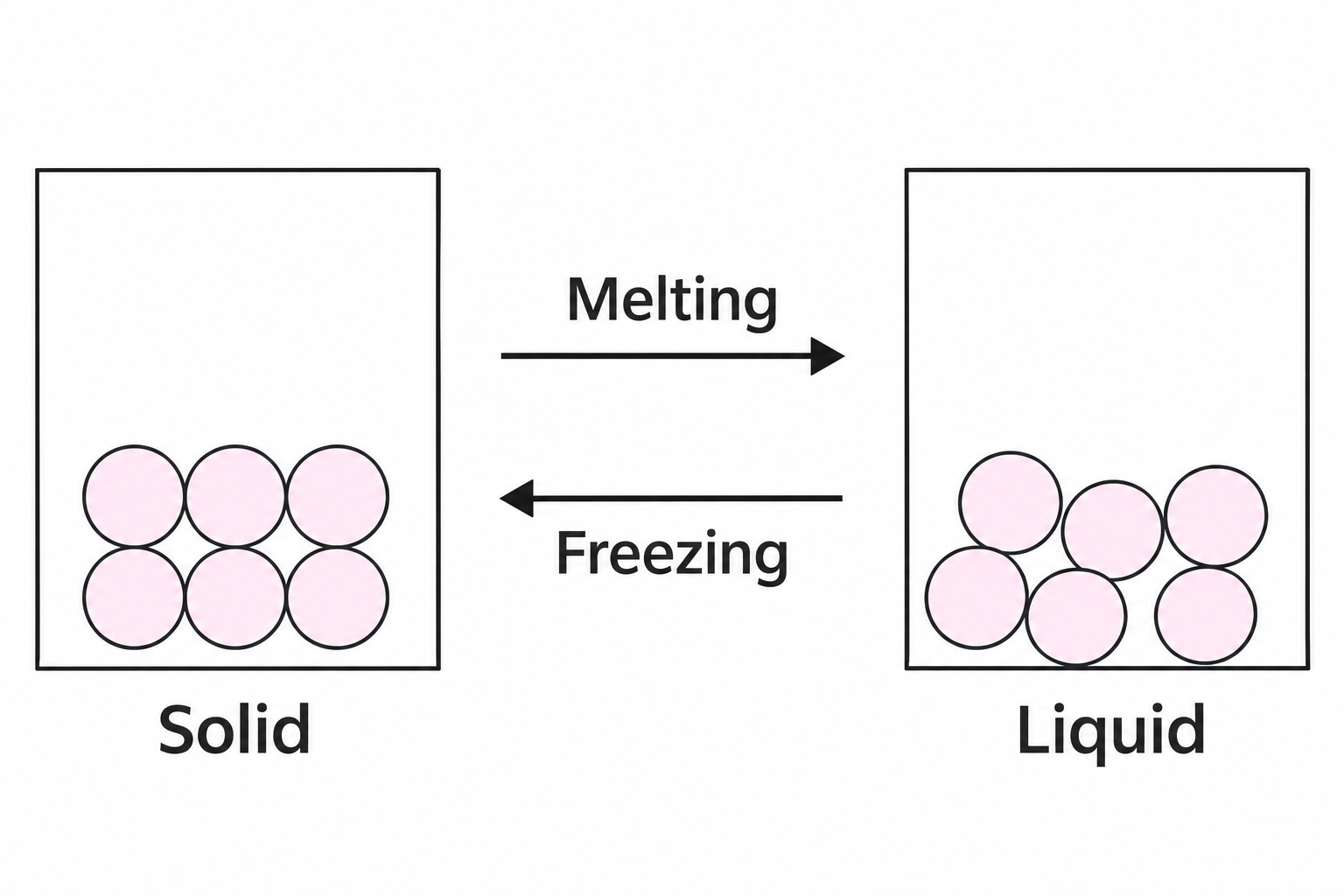
Solid → liquid = Melting
Liquid → solid = Freezing
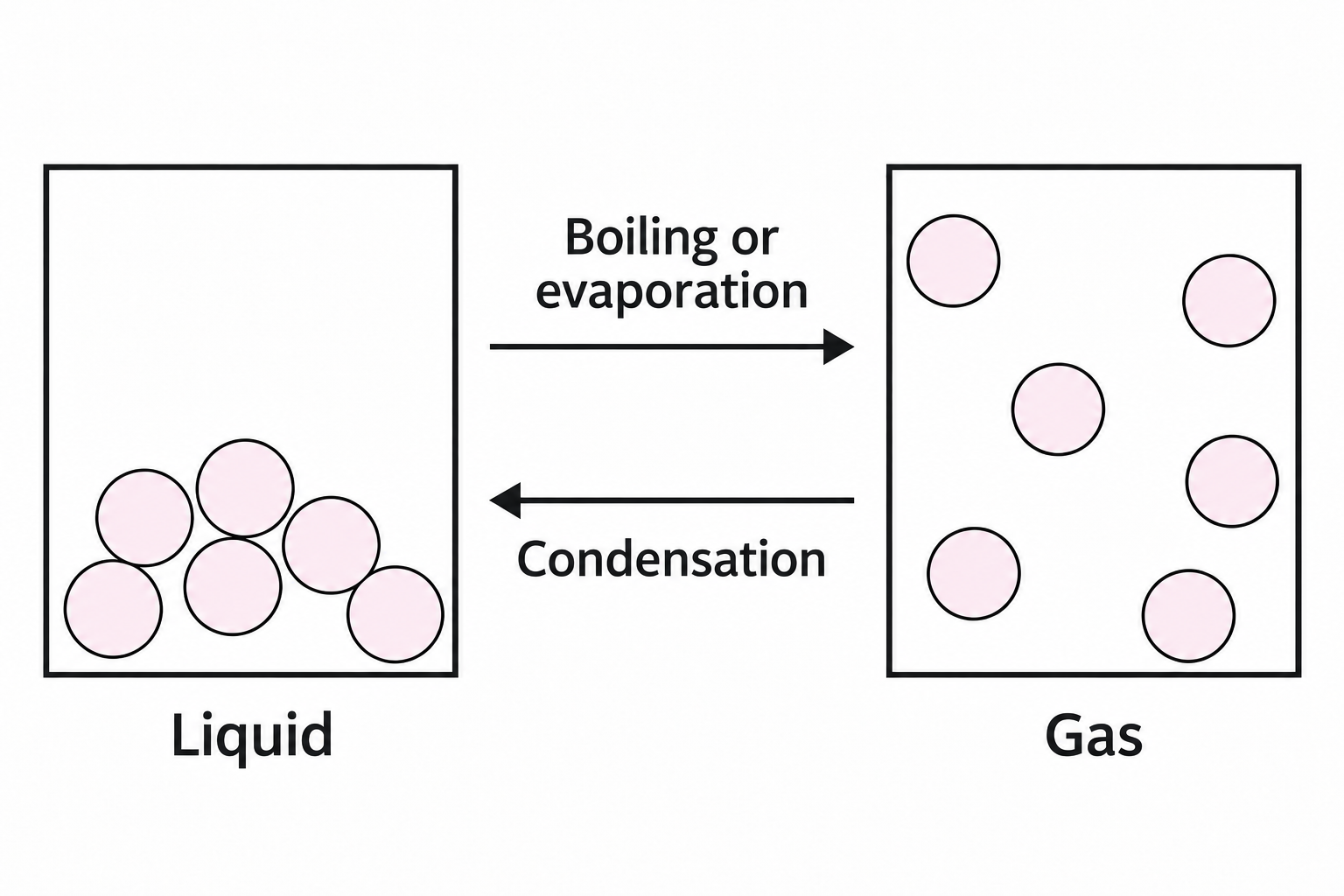
Liquid → gas = Boiling or evaporation
Gas → liquid = Condensation
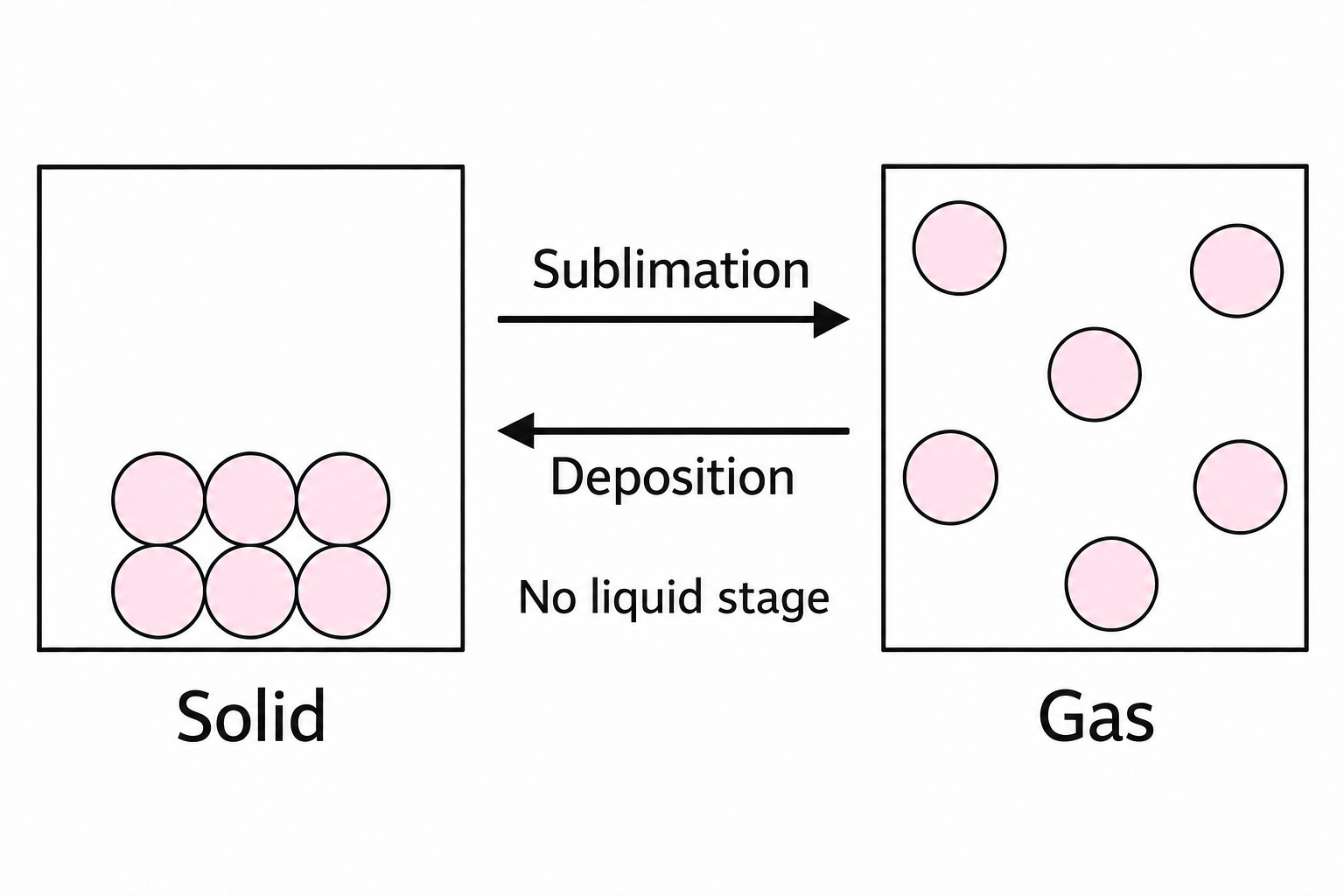
Solid → gas = Sublimation
Gas → solid = Deposition
Sublimation happens without a liquid stage. For example, solid carbon dioxide—dry ice —changes directly into carbon dioxide gas. The reverse change, gas directly to solid, is called deposition.
What changes inside?
These models represent the same sample in three states. Predict what changes—and what stays the same—before selecting a state.
The particles are close together in a regular arrangement. They vibrate about fixed positions.
During melting, the particles become able to move past one another. The particles themselves do not melt.
The particles remain close together, but their arrangement is irregular. They can move past one another.
During freezing, the particles settle into fixed positions but continue to vibrate. When the liquid becomes a gas, its particles become much more widely separated.
The particles are widely separated and move randomly throughout the available space.
During condensation, particles come close together to form a liquid. They remain the same particles.
Which features stayed the same?
The particle type, size and number stayed the same. Their arrangement and movement changed.
No particles entered or left the sample, so its mass stayed the same.
Evaporation and boiling: what is the difference?
Both change a liquid into a gas, but they happen differently. A wet hoodie can dry in a cool room without its water boiling.
Evaporation
Happens at the surface of a liquid. Some particles escape into the surrounding space.
It can happen at temperatures below the boiling point. No bubbles need to form within the liquid.
Boiling
Happens throughout the liquid. Bubbles of the substance’s gas form inside it and rise.
It occurs at the boiling point, which depends on the surrounding pressure.
Pure water boils at about 100°C at normal atmospheric pressure. It can evaporate at room temperature. Water vapour is invisible; the white cloud near a kettle is made of tiny liquid droplets formed by condensation.
Sublimation happens without a liquid stage. For example, solid carbon dioxide—dry ice—changes directly into carbon dioxide gas. The reverse change, gas directly to solid, is called deposition.
Does water have to boil to become a gas?
A damp makeup sponge is left in a room at 20°C. A saucepan of pasta water is boiling at 100°C.
Which can change liquid water into water vapour?
Does changing state change the mass?
Mass is conserved during a change of state. No particles are created or destroyed. If none enter or leave the sample, its mass stays the same.
A sealed container makes this easier to check because it keeps all the substance inside, including any gas.
Will the balance reading change?
A sealed jar containing ice is on a balance. The jar and its contents have a total mass of 180 g.
What will the balance read after all the ice melts?
Could the water’s volume change while its mass stays the same?
Yes. Ice occupies more volume than the same mass of liquid water. When the ice melts, the water occupies less volume.
Its molecules are arranged differently, but the same amount of water remains. A change in volume does not necessarily mean a change in mass.
Why can the measured mass decrease?
If water evaporates from an open container, some water molecules leave and mix with the air. A balance weighing the container and remaining water then reads less.
The missing mass has been transferred to the surroundings as water vapour. It has not been destroyed. The total mass is conserved when the escaped water is included.
A physical change, not a new substance
A change of state is a physical change. No new substance forms, and reversing the change restores the substance’s original properties under the same conditions. Liquid water can freeze back into ice.
A chemical change produces new substances. Candle wax melting is a physical change; candle wax burning is a chemical change.
INTERACTIVE QUICK CHECK
Choose one answer for each question. You’ll see feedback straight away.
A student leaves an open dish of water on a balance. The reading decreases as the water evaporates. She says, “This proves mass is lost during a change of state.” Explain why her conclusion is incorrect.
Water molecules leave the dish as water vapour and mix with the surrounding air. The balance no longer measures those molecules, so its reading decreases.
The water has moved into the surroundings; it has not been destroyed. The total mass of the dish, remaining water and escaped water vapour is conserved.
Use a sealed container and weigh the whole container and its contents. Water can still evaporate inside, but none escapes, so the total balance reading stays the same.
Chapter summary
-
Melting changes solid to liquid;
freezing changes liquid to solid. -
Boiling and evaporation change liquid to gas;
condensation changes gas to liquid. -
Sublimation changes solid directly to gas,
without a liquid stage. The reverse change is deposition. -
Evaporation happens at a liquid’s surface and can occur below
its boiling point. Boiling happens throughout the liquid,
with bubbles of the substance’s gas forming inside it. -
During a change of state, the particles’ arrangement and
movement change. The particles themselves retain their
identity and size. -
Mass is conserved. A sealed sample keeps the
same mass. If substance escapes from an open container,
its balance reading can decrease, but the escaped substance
still has mass. -
Changes of state are physical changes.
No new substance forms. Reversing the change restores the
substance’s original properties under the same conditions.