
PARTICLE MODEL OF MATTER · CHAPTER 2 OF 10
Understanding density
A small metal key can have more mass than a much larger piece of foam. Why? To compare materials fairly, we need to consider how much mass fits into the same volume.
By the end, you’ll be able to…
- Explain density as mass per unit volume.
- Compare the densities of materials using equal volumes.
- Use particle models to explain differences in density.
- Explain why cutting a uniform material into smaller pieces does not change its density.
- Explain how changing a sealed gas’s volume affects its density
Mass, volume and density
Mass tells us how much matter an object contains. We commonly measure it in grams (g) or kilograms (kg). Volume is the amount of space an object occupies. For small solid objects, we often measure volume in cubic centimetres (cm³).
A cube measuring 1 cm along each edge has a volume of 1 cm³.
Density is mass per unit volume. It tells us how much mass there is in each cubic centimetre, or each cubic metre, of a material. A higher density means more mass in the same volume.
Density is different from total mass. A large object can have a lot of mass simply because it contains a large amount of material. To decide which material is denser, we must consider volume as well.
What does “per unit volume” mean?
Imagine dividing a uniform material into lots of equal cubes, each with a volume of 1 cm³. Density tells us the mass of one of those cubes. If every 1 cm³ has a mass of 2 g, its density is 2 g/cm³. We read this as “two grams per cubic centimetre”.
Density can also be given in kg/m³, meaning kilograms per cubic metre. Both units describe mass per unit volume. In Chapter 3, you will use the density equation, choose suitable units and measure density yourself.
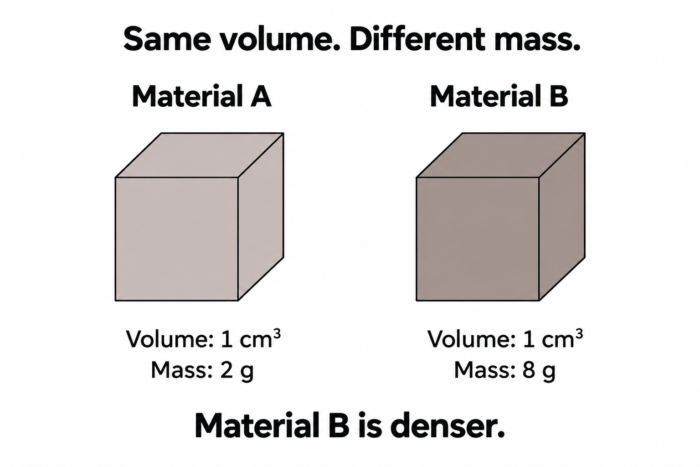
Both cubes occupy the same volume, but Material B has four times the mass. This means Material B is four times denser.
Explaining density with particles
Density depends on the mass of the particles and how closely they are packed. If the particles are identical, fitting more of them into the same volume gives that volume a greater mass and therefore a higher density.
In different substances, the particles can have different masses. Two materials could therefore have the same number of particles in a given volume but different densities. Particle spacing alone is not enough to explain every comparison between materials.
Same volume. Different states.
Compare equal volumes of the same substance as a solid, a liquid and a gas. Each identical circle represents a particle with the same mass.
Solid
Regular arrangement
Liquid
Irregular arrangement
Gas
Spread throughout the space
These are separate samples with equal volumes, so they can contain different numbers of particles. This example shows a substance whose solid is slightly denser than its liquid.
Why does the gas have a much lower density? Reveal answer Hide answer
The same volume contains far fewer particles in the gas. Each particle has the same mass, so fewer particles mean less mass in that volume.
Density is mass per unit volume, so the gas has a much lower density. Its particles are farther apart—not smaller or individually lighter.
Why are the solid and liquid much closer in density? Reveal answer Hide answer
Their particles are closely packed in both states. Equal volumes therefore contain similar numbers of particles and similar masses.
Here, the solid contains slightly more particles in the same volume, so it is slightly denser. This is common, but it is not true for every substance.
Why is ice less dense than liquid water? Reveal answer Hide answer
Water is an exception. Its molecules form a more open arrangement in ice than in liquid water.
Ice
Liquid water
Equal volumes of ice and water contain different numbers of molecules. Ice contains fewer, giving it less mass per unit volume. That is why ice floats on liquid water.
The molecules do not become bigger or lighter when water freezes. Their arrangement changes.
Does a smaller piece have a lower density?
A smaller piece of a material has less mass—but does that mean it has a lower density? Break the chocolate bar below and compare what happens to mass and volume.
Half the bar. Half the density?
This chocolate bar contains colourful sugar-coated sweets. In our model, each half has the same amount of chocolate and the same mix of sweets.
Imagine breaking it into two equal pieces without losing any chocolate or sweets. Will each piece have a lower density?
Half the original volume
Half the original volume
Each piece is smaller and contains less mass. Has the material been squeezed more tightly together, or simply separated into two pieces?
Does either piece have a lower density? Explain why.
No. Each piece has half the original mass and half the original volume. The mass per unit volume stays the same, so each piece has the same average density as the whole bar.
Breaking the bar separates the material; it does not compress it or spread its particles farther apart within each piece. The empty gap between the pieces is not part of either piece’s volume.
Both pieces together still contain all the original chocolate and sweets, so their combined mass is unchanged.
Can density increase without adding more mass?
When you step down in a trainer, a sealed air pocket in its sole compresses. No air escapes—but does its density change? Explore the model below and compare what happens to the gas’s mass and volume.
text inline or in the module Content settings. You can also style every aspect of this content in the module Design settings and even apply custom CSS to this text in the module Advanced settings.
Step down. What happens inside?
Imagine a trainer with a sealed air pocket in its sole. When someone steps down, the pocket compresses. No air can enter or escape.
Predict what happens to the trapped gas’s mass and density when its volume decreases.
Inside the sealed air pocket
In this model, stepping down halves the air pocket’s volume. None of the trapped gas escapes.
Density in everyday life
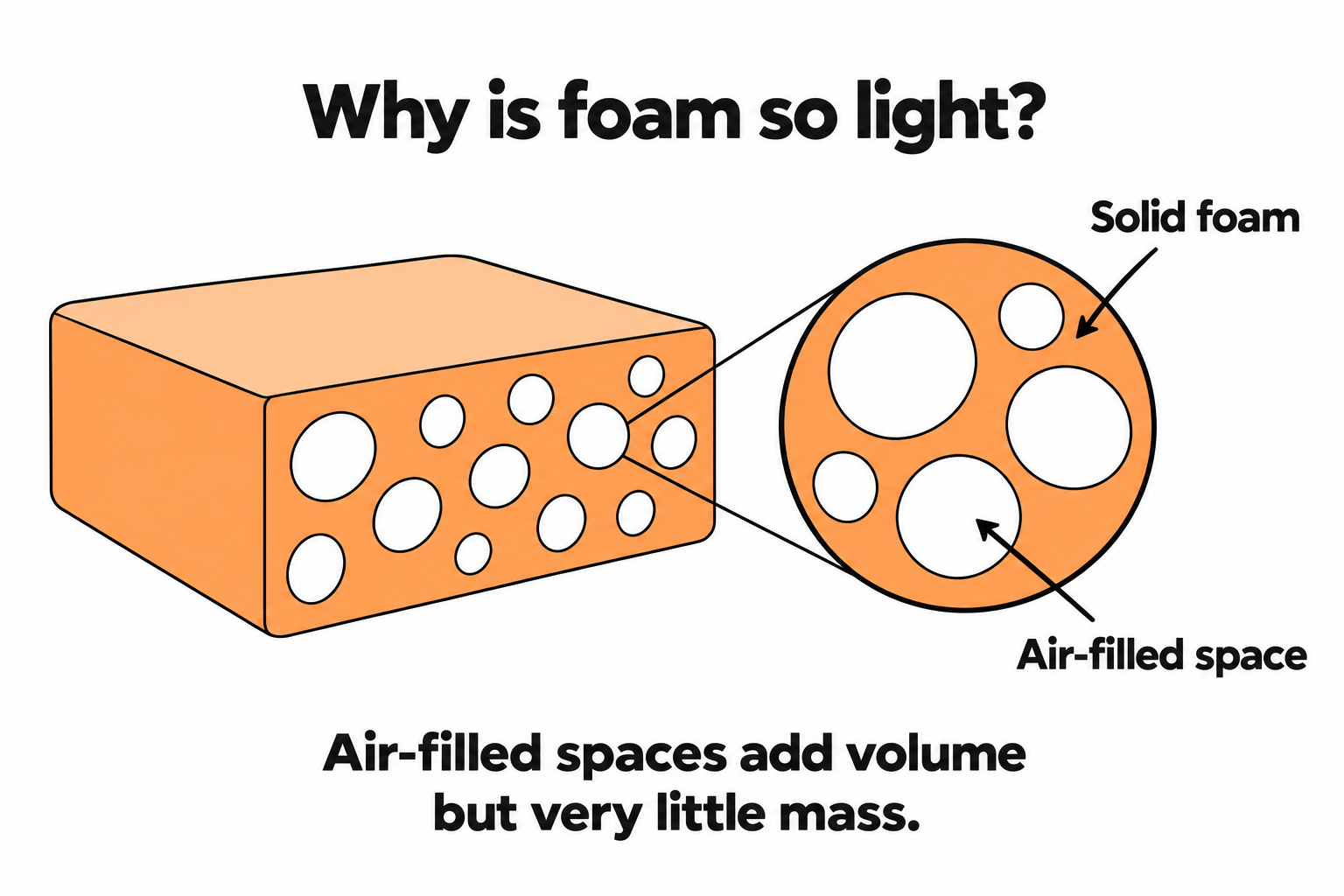
Foam contains many air-filled spaces surrounded by solid material. These spaces contribute to the foam’s overall volume while adding very little mass, giving it a low average density. The spaces shown are pockets of air—not gaps between individual particles.
Check your understanding
Choose an answer for each question. You will see feedback straight away.
Two solid beads have the same volume. Bead X has more mass than bead Y. Which statement is correct?
A uniform plastic ruler snaps into two unequal pieces. No material is lost and the temperature stays the same. How do the pieces’ densities compare?
A sealed, flexible gas container expands to twice its original volume. No gas enters or escapes. What happens to the gas?
A sealed, partly inflated balloon is squeezed into a narrower, longer shape. Its total volume stays the same. A student says, “The air is denser now because the balloon is narrower.” Is the student correct? Explain your answer.
The student is not correct. The balloon is sealed, so no air enters or escapes and the mass of trapped air stays the same. Its total volume also stays the same.
Density is mass per unit volume. Because neither the mass nor the total volume changes, the air’s density is unchanged. Its particles have not become more closely packed overall.
The balloon becomes narrower but longer. A change in one dimension does not prove that its volume has decreased. The air’s density would increase if the same mass were compressed into a smaller total volume.
Chapter summary
- Density describes how much mass there is in each unit of volume. For equal volumes, the material with more mass has a higher density.
- Density depends on the mass of the particles and how closely they are packed.
- Gases usually have much lower densities than solids and liquids because their particles are much farther apart.
- Solids are not always denser than liquids. Ice is less dense than liquid water because its molecules form a more open arrangement.
- Cutting a uniform material into smaller pieces does not change its density when conditions stay the same: mass and volume decrease in the same proportion.
- Compressing a sealed gas increases its density because the same mass occupies less volume.
- Changing shape alone does not change density if mass and total volume stay the same.