
PARTICLE MODEL OF MATTER · CHAPTER 1 OF 10
Particles and states of matter
Why does a pencil keep its shape, a drink take the shape of its glass, and air fill a balloon? The answer lies in how their particles are arranged and how they move.
By the end, you’ll be able to…
- Describe the arrangement and movement of particles in solids, liquids and gases.
- Explain their shape, volume and ability to flow using the particle model.
- Explain why gases are easy to compress but solids and liquids are not.
What is the particle model?
Everything around you is made of particles that are far too small to see individually with your eyes. Depending on the substance, these particles may be atoms or molecules.
The particle model is a simplified way of representing matter. We draw particles as circles or spheres and use their arrangement, movement and interactions to explain how materials behave.
Most familiar substances can exist as a solid, liquid or gas. These are called states of matter.
Solid
Close together.
Vibrate about fixed positions.
Liquid
Close together.
Move past one another.
Gas
Far apart.
Move freely in random directions.
Simplified models — not to scale. Motion is slowed down. Paths illustrate movement; particle collisions are not modelled.
Animations are paused to respect your device’s reduced-motion setting.
How do particles behave in a solid?
A solid has a fixed shape and a fixed volume. A pencil keeps its shape when you put it in a pencil case. It does not spread out to fill the available space.
In a solid, particles are very close together. Attractions between neighbouring particles hold them in fixed positions relative to one another.
However, the particles are not completely still. They vibrate about their fixed positions. They move back and forth, but they do not move freely through the solid.
Many solids have a regular particle arrangement, which is why GCSE diagrams often show neat rows of particles. Not every solid has this regular structure.
How do particles behave in a liquid?
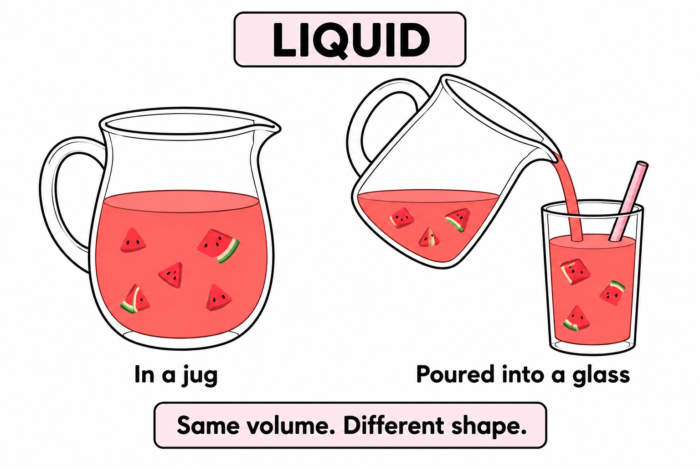
A liquid has a fixed volume, but it does not have a fixed shape. When you pour water from a bottle into a glass, its shape changes while its volume stays approximately the same, provided none is spilled.
Liquid particles are still close together, but they are arranged irregularly. They move randomly and can move past one another. This allows a liquid to flow.
A liquid takes the shape of the part of its container that it occupies. It does not normally expand to fill the entire container: a little water stays at the bottom of a large bottle.
How do particles behave in a gas?
A gas has no fixed shape and no fixed volume. It spreads out to fill the available space in its container.
Gas particles are much farther apart than particles in solids and liquids. They move rapidly in random directions, travelling in straight lines between collisions.
The particles collide with one another and with the container walls. Their movement carries them throughout the available space. Air may be invisible, but it contains particles.
Why can liquids and gases flow?
Liquids and gases are called fluids because they can flow. Their particles can move from place to place. In a liquid, particles stay close together but move past one another; gas particles move freely throughout the available space.
Solid particles also move, but they vibrate about fixed positions rather than moving freely past their neighbours.
What happens when you tilt it?
A student says, “Anything that changes shape must be a liquid.” Explore the three models. What evidence shows that this statement is wrong?
Will the solid keep its shape, or flow to match the bottom of the tilted container?
The solid keeps its shape. It does not flow to match the container.
EXPLAIN IT WITH PARTICLESIts particles are closely packed and vibrate about fixed positions. They remain in fixed positions relative to their neighbours.
A whole solid can slide or tip. That changes its position, rather than its shape.
A solid has a fixed shape and a fixed volume. Its particles vibrate; they are not completely still.
Will the liquid keep its original shape, or move into the lower part of the tilted container?
The liquid changes shape as it moves towards the lower side. Once it settles, its surface is horizontal.
EXPLAIN IT WITH PARTICLESLiquid particles are close together but can move past one another. This allows the liquid to flow and rearrange.
The same particles remain in the container. They do not become smaller or spread throughout all the empty space.
A liquid has a fixed volume but no fixed shape. It takes the shape of the part of its container it occupies.
Will the gas collect at the bottom, or continue to occupy the whole container?
The gas continues to fill the whole container. It does not form a pool at the bottom.
EXPLAIN IT WITH PARTICLESGas particles are far apart and move rapidly in random directions. They continue moving throughout the available space.
This sealed container has not changed its size, so the gas occupies the same volume after tilting.
A gas has no fixed shape and no fixed volume. It spreads out to fill the available space in its container.
Simplified particle illustrations — not to scale. Liquid movement and settling are schematic. Paths repeat, and particle collisions are not calculated.
Continuous motion is paused to respect your device’s reduced-motion setting. You can still tilt the container.
Why are gases easier to compress?
To compress something means to reduce its volume by squeezing it. Imagine two sealed syringes: one contains air, and the other is completely filled with water, with no trapped air. Which plunger do you think will be easier to push in?
Can you squeeze it?
A sealed syringe contains air or water. Predict what will happen when you try to push the plunger in.
Predict how far the plunger will move. What might happen to the particles inside?
The plunger moves in noticeably. The air occupies a smaller volume.
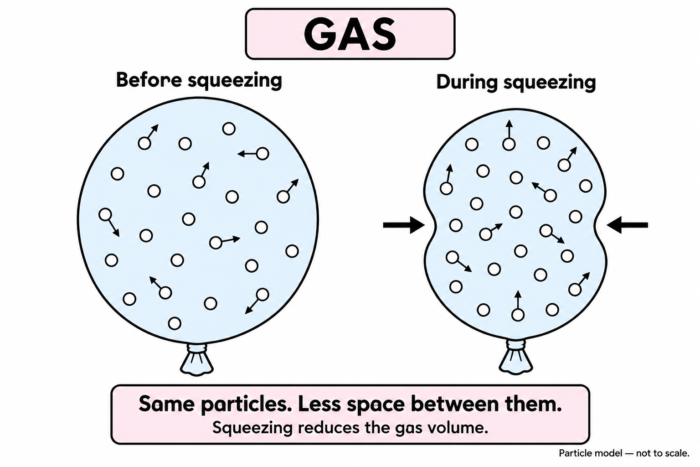
EXPLAIN IT WITH PARTICLESGas particles have large spaces between them. Compression reduces these spaces, bringing the particles closer together.
The particles stay the same size. None disappear or escape from the sealed syringe.
Gases are easy to compress because their particles are far apart. Compression reduces the space between particles, not the size of the particles.
The syringe is completely filled with water, with no trapped air. Will the plunger move as far?
The plunger barely moves. The water’s volume is almost unchanged.
EXPLAIN IT WITH PARTICLESLiquid particles are already close together. There is very little space between them to reduce.
Being able to flow does not mean a liquid is easy to compress. Its particles can move past one another while remaining close together.
Liquids are almost incompressible because their particles are closely packed. Solids are also difficult to compress.
Simplified models — not to scale. Particle size and number stay the same during compression. The movement shown is illustrative, rather than a measured response to a particular force.
☆ Solids are also difficult to compress because their particles are closely packed. At GCSE, we describe solids and liquids as almost incompressible.
Same particles, different behaviour
A material’s properties depend on how its particles are arranged, how they move and how they interact.
An individual water molecule is not “solid” in ice or “liquid” in water. Solid, liquid and gas describe the behaviour of a collection of particles.
When ice melts, the water molecules remain water molecules. Their arrangement and movement change. We will explore changes of state in a later chapter.
Avoid describing individual particles as “hard”, “runny” or “squashy”. These describe properties of the material as a whole.
True or misconception?
Three statements are true and three contain a misconception. Can you explain which is which?
Check your understanding
Choose an answer for each question. You will see feedback straight away.
A sealed, partly inflated balloon changes shape when Mia gently squeezes it. Does this prove that the air inside is a liquid? Explain your answer using particles.
No. Both liquids and gases can change shape because their particles can move from place to place.
Air is a gas: its particles are far apart and move randomly throughout the available space. When Mia squeezes one part of the balloon, the air can move into another part.
Changing shape alone does not distinguish a liquid from a gas. Compressibility is a useful difference: gases are easy to compress, whereas liquids are difficult to compress.
CHAPTER 1
Chapter summary
- The particle model explains the properties of matter using particle arrangement, movement and interactions.
- In a solid, closely packed particles vibrate about fixed positions. Solids have a fixed shape and a fixed volume.
- In a liquid, particles are close together in an irregular arrangement and can move past one another. Liquids have a fixed volume but take the shape of the part of their container they occupy.
- In a gas, particles are far apart and move rapidly in random directions. Gases have no fixed shape or volume and fill the available space.
- Liquids and gases are fluids: they can flow because their particles can move from place to place.
- Gases are easy to compress because there are large spaces between their particles. Solids and liquids are difficult to compress because their particles are already close together.
- Compressing a gas reduces the spaces between its particles. The particles themselves do not shrink, and their number stays the same in a sealed container.