
ELECTRICITY · CHAPTER 12 OF 13
Power and energy
Electrical devices transfer energy. Power tells us how quickly that transfer happens—and explains why some appliances do much more each second than others.
By the end, you’ll be able to…
- Describe power as the rate at which energy is transferred.
- Calculate electrical power and energy using the appropriate equations.
- Compare the energy transferred by different electrical appliances.
How many joules are transferred each second?
Each yellow circle represents 1 joule of energy. Compare how much energy is transferred to each device every second.
Energy transfers more slowly
Fewer joules reach the device each second.
Energy transfers more quickly
More joules reach the device each second.
Power is measured in watts
1W = 1J/s
ELECTRICAL POWER
Potential difference and current determine power
Each coulomb transfers an amount of energy determined by the potential difference. Current tells us how many coulombs pass each second. Combining them gives the rate of energy transfer.
The equation
power = potential difference × current
P = V × I
P power in watts (W)
I current measured in amps (A)
V potential difference measured in volts (V)
To calculate power:
P = V × I
A hairdryer is connected to a 230 V supply and draws a current of 5 A. Calculate its power.
P = V × I
P = 230 × 5
P = 1150 W
To calculate potential difference:
V = P ÷ I
An LED make-up mirror has a power of 12 W and draws a current of 1 A. Calculate the p.d. across it.
V = P ÷ I
V = 12 ÷ 1
V = 12 V
To calculate current:
I = P ÷ V
A phone charger transfers power at 20 W when the potential difference is 10 V. Calculate the current.
I = P ÷ V
I = 20 ÷ 10
I = 2 A
☆ Large powers use kilowatts
POWER IN A RESISTOR
Current causes heating
When current flows through resistance, electrical energy is transferred by heating. Combining P = VI with V = IR gives another useful equation.
The equation
power = (current)squared × resistance
Match the power rating to each device
Each device is connected to a 230 V supply. Use its current and P = V × I to work out the correct power rating.
LED lamp

Which power rating belongs to this device?
Television

Which power rating belongs to this device?
Hairdryer
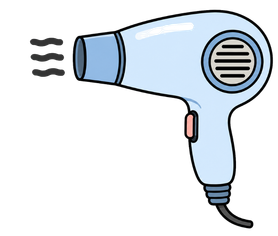
Which power rating belongs to this device?
POWER AND TIME
Energy transferred depends on power and time
Power tells us how much energy is transferred each second. The longer a device is switched on, or the greater its power, the more energy it transfers.
The equation
energy = power × time
E = P × t
E energy in joules (J)
P power measured in watts (W)
t time measured in seconds (s)
To calculate energy:
E = P × t
A gaming monitor has a power of 60 W and is switched on for 2 minutes. Calculate the energy transferred.
First convert the time into seconds:
2 min = 2 × 60
2 min = 120 s
E = P × t
E = 60 × 120
E = 7200 J
To calculate power:
P = E ÷ t
A games console transfers 18 000 J of energy in 100 seconds. Calculate its power.
P = E ÷ t
P = 18 000 ÷ 100
P = 180 W
To calculate time:
t = E ÷ P
A heated blanket transfers 24 000 J of energy at a power of 80 W. Calculate how long it is switched on for.
t = E ÷ P
t = 24 000 ÷ 80
t = 300 s
☆Power and energy are not the same.
Power is the rate of transfer. Energy is the total transferred during a period of time.
ENERGY PER COULOMB
Energy also depends on charge and potential difference
Potential difference tells us the energy transferred by each coulomb. Multiply it by the total charge that passes to find the total energy.
The equation
energy = charge × potential difference
E energy in joules (J)
Q charge measured in coulombs (C)
V potential difference measured in volts (V)
To calculate energy:
E = Q × V
A portable speaker has a potential difference of 12 V across it. A charge of 500 C flows through it. Calculate the energy transferred. Give your answer in kilojoules.
E = Q × V
E = 500 × 12
E = 6000 J
6000 J = 6 kJ
E = 6 kJ
To calculate charge:
Q = E ÷ V
A laptop charger transfers 4.6 kJ of energy through a potential difference of 230 V. Calculate the charge that flows.
First convert the energy into joules:
4.6 kJ = 4600 J
Q = E ÷ V
Q = 4600 ÷ 230
Q = 20 C
To calculate potential difference:
V = E ÷ Q
A rechargeable LED light transfers 360 J of energy when 30 C of charge flows. Calculate the potential difference.
V = E ÷ Q
V = 360 ÷ 30
V = 12 V
POWER IN A RESISTOR
Current and resistance determine power
When current flows through a component with resistance, electrical energy is transferred to its thermal energy store. The power transferred depends on both the current and the resistance.
The equation
power = current squared × resistance
P = I² × R
P power in watts (W)
I current measured in amps (A)
R resistance measured in ohms (Ω)
To calculate power:
P = I² × R
A heated hairbrush has a resistance of 20 Ω and a current of 2 A flows through it. Calculate its power.
P = I² × R
P = 2² × 20
P = 4 × 20
P = 80 W
To calculate resistance:
R = P ÷ I²
A heating element transfers power at 180 W when a current of 3 A flows through it. Calculate its resistance.
R = P ÷ I²
R = 180 ÷ 3²
R = 180 ÷ 9
R = 20 Ω
To calculate current:
I = √(P ÷ R)
A heated seat has a power of 200 W and a resistance of 8 Ω. Calculate the current flowing through it.
I = √(P ÷ R)
I = √(200 ÷ 8)
I = √25
I = 5 A
☆ Doubling the current makes the heating power four times larger. The current is squared: (2I)² = 4I²
Choose the right answer
Each question uses a different electrical equation. Look carefully at the quantities and units before choosing your answer.
Hair straighteners
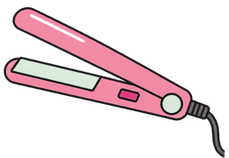
Hair straighteners have a power of 50 W and are switched on for 2 minutes. How much energy do they transfer?
Mobile phone charger
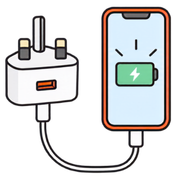
A phone charger transfers 240 J of energy when 48 C of charge passes through it. What is the potential difference?
Heated hairbrush

A heated hairbrush has a resistance of 20 Ω. A current of 3 A flows through its heating element. What is its power?
Check your understanding
Choose one answer for each question. You will see feedback straight away.
Why does a high-current cable become dangerously hot?
When a current flows through a cable, energy is transferred to the thermal energy store of the cable. The power transferred can be calculated using:
P = I2 × R
Because the current is squared, even a moderate increase in current can cause a much larger increase in the rate of energy transfer. This can make the cable dangerously hot.
Chapter summary
- Power is the rate at which energy is transferred. It is measured in watts (W), where 1 W = 1 J/s.
- Electrical power depends on potential difference and current: P = V × I.
- The energy transferred by a device depends on its power and how long it operates: E = P × t.
- Energy transferred can also be calculated from the charge that flows and the potential difference: E = Q × V.
- For a resistor, power can be calculated using P = I2R. Because current is squared, increasing the current can greatly increase the rate of energy transfer.
- Power and energy are not the same. Power tells you how quickly energy is transferred; energy is the total amount transferred.