
ELECTRICITY · CHAPTER 11 OF 13
Series and parallel circuits
Components can share one route around a circuit or sit on separate branches. That choice changes the current, potential difference and resistance.
By the end, you’ll be able to…
- Compare the arrangement of components in series and parallel circuits.
- Describe how current behaves in series and parallel circuits.
- Describe how potential difference is shared in each type of circuit.
How many paths can charge take?
Look at the junctions. A series circuit has one continuous route. A parallel circuit contains junctions where the route divides into branches and later rejoins.
Series circuit
Electrons have one continuous route and pass through both bulbs.
Parallel circuit
Electrons split between the branches and later rejoin.
In the series circuit, the two identical bulbs share the cell’s 6 V potential difference, so each bulb has 3 V across it. The total resistance is higher, so the current from the cell is smaller and both bulbs are dimmer.
In the parallel circuit, each branch has the full 6 V potential difference across it. The total resistance is lower, so the current from the cell is larger and both bulbs are brighter.
SERIES CIRCUITS
One route for charge
Current
The same current flows through every component because there is only one route.
I₁ = I₂ = I₃
Potential difference
The supply potential difference is shared between the components.
Vₛᵤₚₚₗᵧ = V₁ + V₂
Resistance
The component resistances add together.
Rₜₒₜₐₗ = R₁ + R₂
PARALLEL CIRCUITS
More than one route for charge
Current
Current divides between the branches at a junction. When the branches rejoin, the currents combine again.
Iₜₒₜₐₗ = I₁ + I₂
Potential difference
Each branch has the full supply potential difference across it.
Vₛᵤₚₚₗᵧ = V₁ = V₂
Resistance
Adding another branch gives charge another route through the circuit, so the total resistance decreases.
Rₜₒₜₐₗ < resistance of the smallest branch
☆ Current is not used up. If an ammeter reads 0.5 A before a bulb in a series circuit, it also reads 0.5 A after it. The bulb transfers energy, not charge.
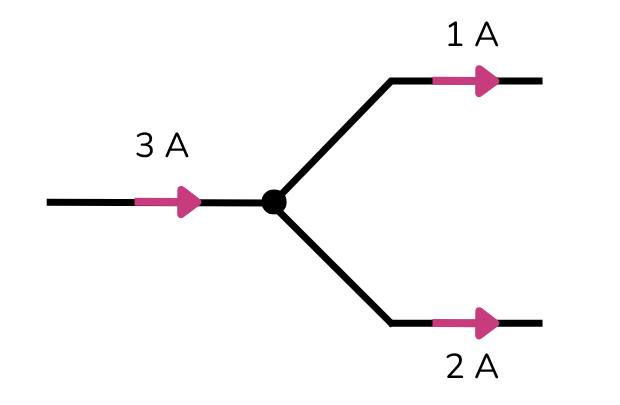
At a junction
Current entering a junction equals the total current leaving it.
3 A enters → 1 A + 2 A leave
How to calculate total resistance
Resistance in series
worked example
Two resistors of 4 Ω and 6 Ω are connected in series. Calculate the total resistance.
Rₜₒₜₐₗ = R₁ + R₂
Rₜₒₜₐₗ = 4 + 6
Rₜₒₜₐₗ = 10 Ω
In series, adding resistors increases the total resistance.
Resistance in series
worked example
Two 6 Ω resistors are connected in parallel. Calculate the total resistance.
1/Rₜₒₜₐₗ = 1/R₁ + 1/R₂
1/Rₜₒₜₐₗ = 1/6 + 1/6
1/Rₜₒₜₐₗ = 2/6 = 1/3
Therefore:
Rₜₒₜₐₗ = 3 Ω
In parallel, the total resistance is less than the resistance of either branch.
Circuit detective
Use the rules for series and parallel circuits to work out the missing meter readings and total resistances.
Find the missing meter readings
A 9 V cell supplies two bulbs connected in series. Use the readings shown to work out the two missing values.
What does ammeter A₂ read?
What is the potential difference V₂?
Find the missing branch readings
A total current of 3 A reaches a junction. The two branches are connected across a 6 V cell.
What is the current I₂?
What is the potential difference V₂?
Compare the arrangements
Two identical 6 Ω resistors can be connected in series or in parallel. Select the correct total resistance for each arrangement.
What is the total resistance in series?
What is the total resistance in parallel?
Why are appliances in homes connected in parallel?
Appliances in homes are connected in parallel so that they can work independently.
✓ Each appliance receives the full mains potential difference.
✓ Switching one appliance off does not break the circuit for the others.
✓ If one appliance stops working, the others can continue to work.
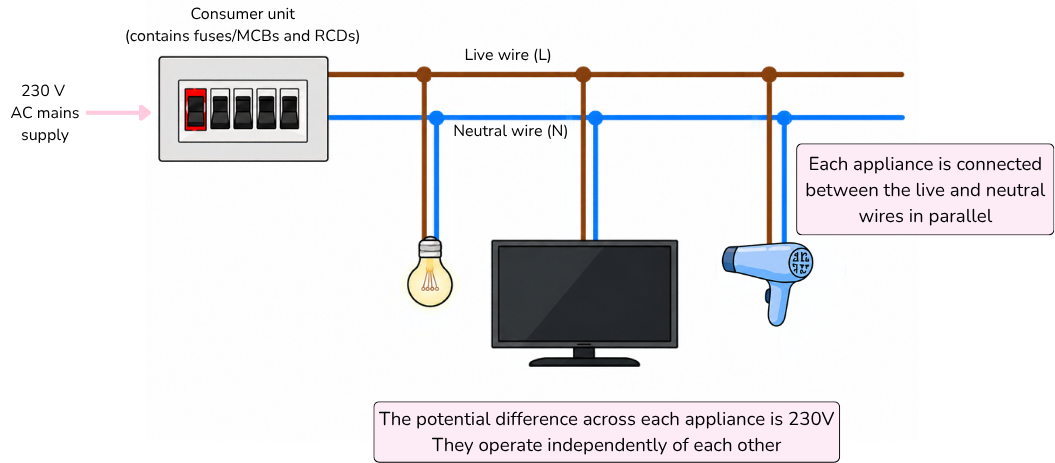
This is a simplified diagram. Real household wiring also includes safety features and earth wires where required. Here, only the live and neutral wires are shown to make the parallel arrangement clear.
Check your understanding
Answer all three questions about series and parallel circuits.
Why does adding a parallel branch increase the total current from the cell?
The extra branch provides another route for charge, reducing the circuit’s total resistance. With the same supply potential difference, a lower total resistance produces a larger total current.
Chapter summary
- A series circuit has one route for charge, while a parallel circuit has two or more branches.
- In a series circuit, the current is the same through every component. In a parallel circuit, current divides at junctions and combines again when the branches rejoin.
- In series, the supply potential difference is shared between the components. In parallel, each branch has the full supply potential difference across it.
- In series, the total resistance is the sum of the component resistances.
- Adding another branch in parallel decreases the total resistance. The total resistance is less than the resistance of the smallest branch.