
ELECTRICITY · CHAPTER 8 OF 13
Potential difference
Potential difference tells us how much energy is transferred for each coulomb of charge.
By the end, you’ll be able to…
- describe potential difference as energy transferred per coulomb of charge
- interpret one volt as one joule per coulomb
- distinguish between current and potential difference
- use and rearrange the equation V = E ÷ Q.
How energy is transferred around a circuit
A cell transfers energy to the circuit. Moving charge allows this energy to be transferred to components such as bulbs, motors and resistors.
1 Cell
Transfers energy to the charges.
→
2Moving charge
Transfers energy around the circuit.
→
3Component
Transfers energy to the surroundings.
*The charge is not used up. It continues around the complete circuit, but energy is transferred from the electrical pathway to the surroundings.
The meaning of voltage
Potential difference is energy per coulomb
A larger potential difference means that more energy is transferred for each coulomb of charge.
1 Volt = 1 joule per coulomb
1 V= 1 J/C
Potential difference is measured between two points. Across a cell, it tells us how much energy is transferred to each coulomb of charge. Across a component, it tells us how much energy each coulomb transfers to the surroundings. Potential difference is often called voltage.
See what potential difference means
Each blue charge packet represents 1 C. Choose a potential difference and see how much energy each coulomb receives from the cell and transfers at the bulb.
Current and potential difference are different
Current, I
How much charge flows past a point each second. Measured in amperes (A).
Potential difference, V
How much energy is transferred per coulomb of charge. Measured in volts (V).
☆ Potential difference is not the amount of charge flowing. A circuit can have a potential difference even when no current is flowing—for example, when a switch is open.
The equation
potential difference= energy ÷ charge
V = E ÷ Q
V potential difference (V)
E energy measured in joules (J)
Q charge measured in coulombs (C)
Rearranging the equation
The relationship between potential difference, energy and charge can be written in three different ways. Choose the version that has the quantity you need to calculate on its own.
To calculate voltage:
V = E ÷ Q
A bulb transfers 12 J of energy when 4 C of charge passes through it. Calculate the potential difference.
V = E ÷ Q
V = 12 ÷ 4
V = 3 V
To calculate energy:
E = Q × V
A motor has a potential difference of 6 V across it. A charge of 5 C passes through it. Calculate the energy transferred.
E = Q × V
E = 5 × 6
E = 30 J
To calculate charge:
Q = E ÷ V
A component transfers 24 J of energy with a potential difference of 8 V across it. Calculate the charge that passes through it.
Q = E ÷ V
Q = 24 ÷ 8
Q = 3 C
A lift model for potential difference
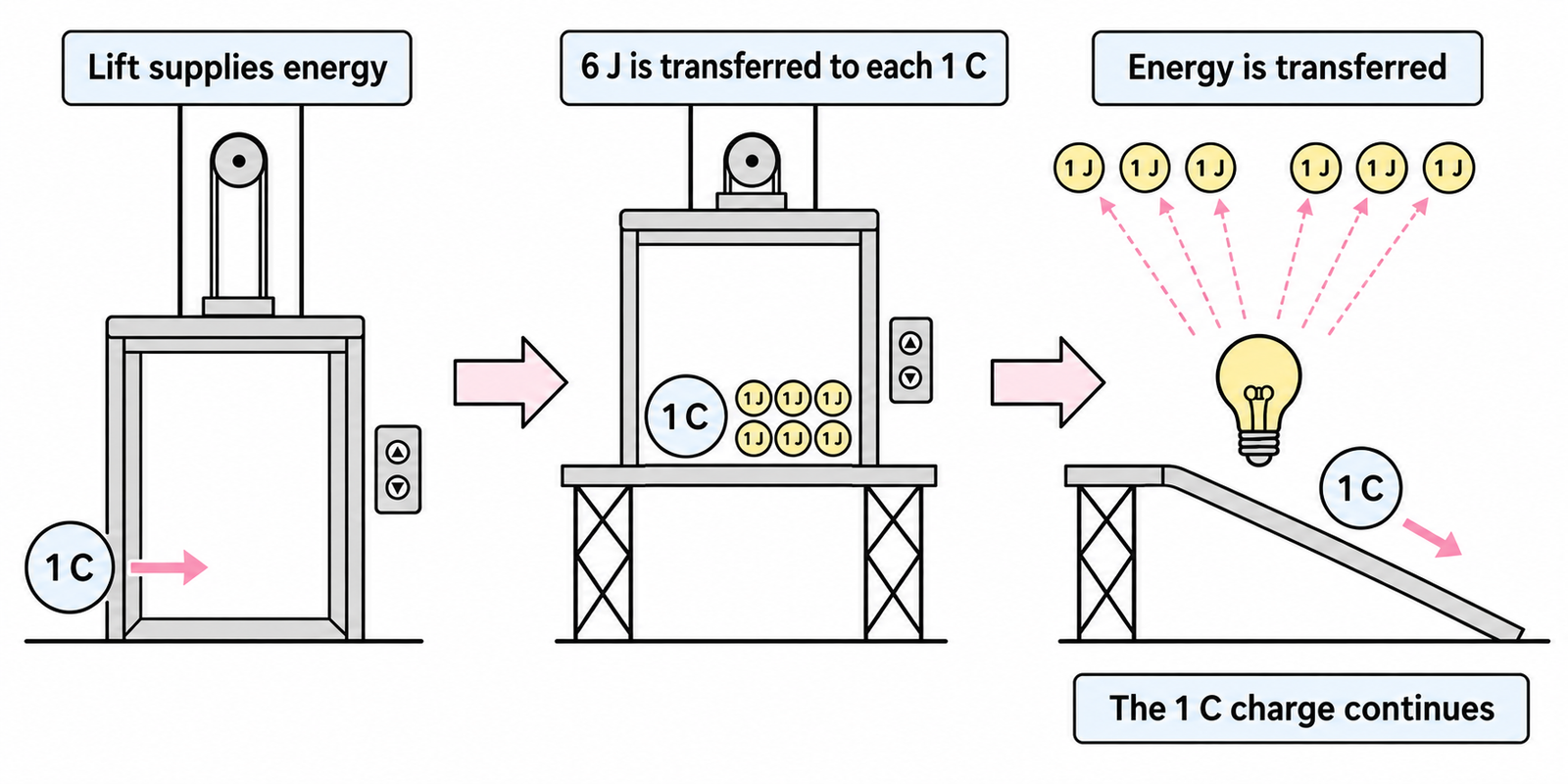
The cell acts like a lift: it transfers 6 J of energy to every coulomb of charge, so its potential difference is 6 V. The charge transfers this energy to the bulb, where it is transferred to the surroundings, but the charge itself continues around the circuit—it is not used up.
Model limitation: Charges do not literally carry boxes of energy or travel around a circuit on a track. The lift model simply shows that a cell transfers energy to charges and components transfer energy to the surroundings.
Check your understanding
Answer all three questions about potential difference.
Two bulbs transfer the same total energy, but twice as much charge passes through Bulb B. Which bulb has the larger potential difference?
Bulb A. Since V = E ÷ Q, transferring the same energy with half as much charge means twice as much energy is transferred per coulomb.
CHAPTER 8
Chapter summary
- Potential difference is the energy transferred for every coulomb of charge that moves between two points.
- Potential difference is measured in volts (V). One volt means that one joule of energy is transferred per coulomb: 1 V = 1 J/C.
- Across a cell, energy is transferred to the charges. Across a component, energy is transferred from the charges to the surroundings.
- Potential difference and current are different: current describes charge flowing each second, while potential difference describes energy transferred per coulomb.
- Potential difference can be calculated using V = E ÷ Q, where E is energy transferred in joules and Q is charge in coulombs.