
ELECTRICITY · CHAPTER 9 OF 13
Measuring potential difference
A voltmeter compares the energy transferred per coulomb between two points, so it must be connected across the component being measured.
By the end, you’ll be able to…
- explain how a voltmeter is connected in a circuit
- read potential difference from analogue and digital voltmeters
- record potential difference using the correct unit
Potential difference is measured with a voltmeter
Potential difference is measured in volts, with the unit symbol V. A voltmeter measures the energy transferred per coulomb of charge between two points.
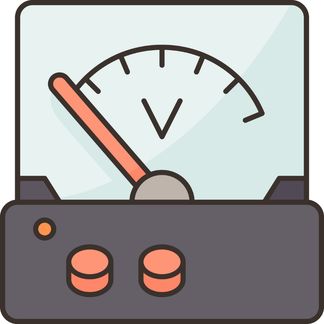
This is an image of an analogue voltmeter.
Unit: volt (V)
A device used to measure potential difference. Its circuit symbol is a circle containing the letter V.
How is a voltmeter connected?
Incorrect: connected in series
A voltmeter has a very high resistance. Putting it in the main path would greatly reduce the current and change the circuit.
Connected in parallel
The two voltmeter leads connect to opposite sides of the component, allowing it to compare those two points.
Where should the voltmeter go?
Select one of the three positions, then press Test position. A voltmeter measures the potential difference between two points, so it needs one connection on each side of the bulb.
☆ A voltmeter connected across the cell measures the cell’s potential difference. Connected across the bulb, it measures the bulb’s potential difference.
How do you read an analogue voltmeter?
First, find the difference between two labelled values. Count the number of equal intervals between them, then divide to find the value of one interval. Finally, use the needle position to determine the reading.
*Count the spaces between the scale marks—not the marks themselves.
Practise reading an analogue voltmeter
This scale runs from 0 V to 6 V. Choose a mystery reading, then work out the value shown.
Choose a mystery reading:
What potential difference does the needle show?
The reading here is 4.20 V. Never just write “4.20”—a measurement needs its unit!
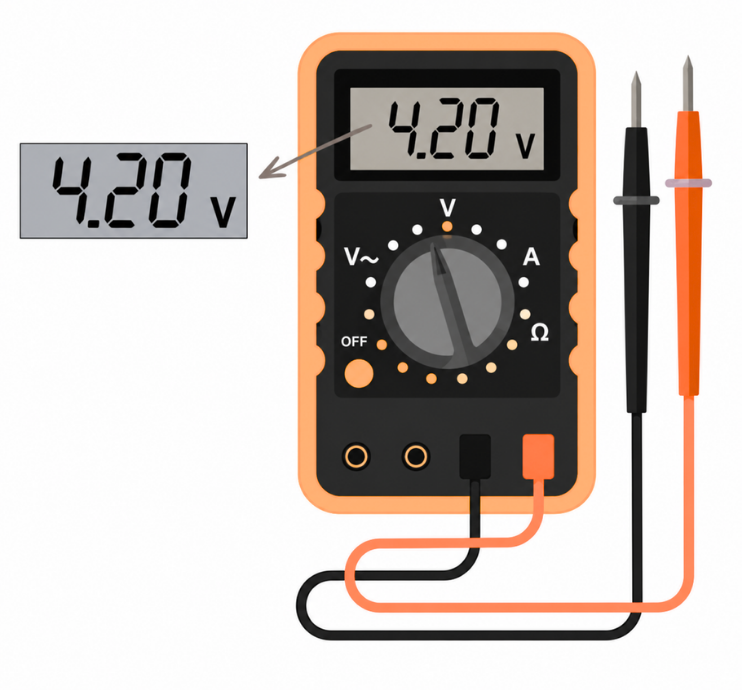
Digital Voltmeters
A digital display gives the reading directly
A digital voltmeter removes the need to interpret a scale. The potential difference is shown directly on the display, but you must still record the correct unit and pay attention to the number of decimal places shown.
Check your understanding
Answer all three questions about measuring potential difference.
A student says, “A voltmeter measures the current that passes through it, so it should be connected in series like an ammeter.” Explain why this is incorrect.
A voltmeter measures the potential difference between two points, so it is connected in parallel across a component. It has a very high resistance, so very little current flows through it and it does not significantly change the circuit.
CHAPTER 9
Chapter summary
- Potential difference is measured between two points using a voltmeter and is recorded in volts (V).
- A voltmeter is connected in parallel across the component being measured.
- A voltmeter has a very high resistance so that it draws very little current and does not significantly change the circuit.
- To read an analogue voltmeter, calculate the value of one scale interval before reading the needle.