
ELECTRICITY · CHAPTER 1 OF 13
Introducing electric circuits
A torch lights up. A little fan spins. A doorbell sounds. Different results—but each can happen because electrical components are working together in a circuit.
By the end, you’ll be able to…
- Identify the main parts of a simple electric circuit and explain what each part does.
- Recognise the circuit symbols for common components.
- Explain how changing the output component changes what the circuit does.
What is an electric circuit?
An electric circuit is a group of electrical components connected by conducting wires.
Each component has a particular job. The cell provides energy, the wires connect the components, the switch controls the circuit and an output component transfers energy to its surroundings.
For the components to operate, they must be connected correctly. In the next chapter, we will investigate why the conducting path must form a complete loop.
Real components and circuit symbols
Real electrical components come in many shapes and sizes. For example, two lamps may look different even though they perform the same job.
Circuit diagrams use standard symbols instead of realistic pictures. This makes circuits quicker to draw and easier for people to understand. A particular symbol always represents the same type of component.
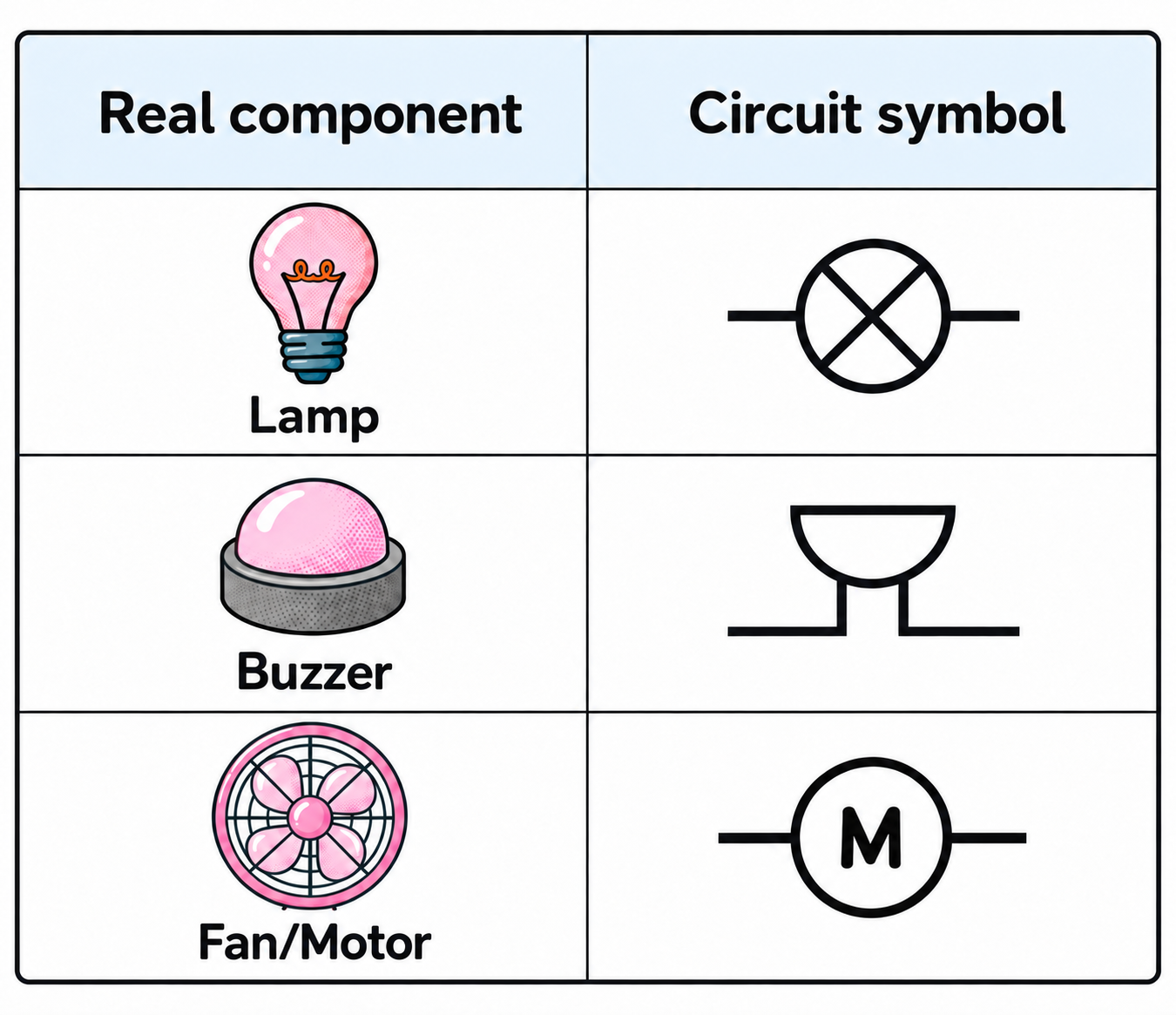
01 — Cell or battery
Provides the energy that can be transferred to the other components. A battery consists of two or more cells connected together.
02 — Connecting wires
Join the components and provide a conducting path between them.
03 — Switch
Opens or closes the path, letting us control whether the circuit operates.
04 — Output component
Produces an effect—for example, light from a lamp, movement from a motor or sound from a buzzer.
What can a circuit do?
Choose a lamp, motor or buzzer. Close the switch and watch the output. Then try another component.
The output is off. Close the switch to complete the path.
Energy is transferred electrically from the cell to the lamp. The lamp transfers energy to its surroundings by light and heating.
Energy is transferred electrically from the cell to the motor. The motor makes the attached fan spin.
Energy is transferred electrically from the cell to the buzzer. Vibrations produce sound; the pulsing pink lines represent sound waves. This model does not play audio.
Simplified model: the motor has a fan attached. The fan shows the motor’s movement; the pink waves beside the buzzer symbol represent sound. Animation speed is illustrative.
What’s happening?
Same circuit. Different job.
The cell, wires and switch stay the same when you change the output. What changes is the effect: light, movement or sound.
The cell supplies energy; the output component transfers it. Real lamps, motors and buzzers also warm up, so not all the transferred energy produces the effect we want.
The switch is not the energy source
Pressing a switch controls the circuit—it does not supply the energy that keeps the lamp lit or the motor turning. In this circuit, that energy comes from the cell.
How do components transfer energy?
Each component produces a useful effect, but it also transfers some energy by heating.
Check your understanding
Choose an answer for each question. You will see feedback straight away.
Why does the switch work anywhere in the loop?
Opening it anywhere creates a gap in the only path, stopping the flow of charge around the entire circuit.
CHAPTER 1
Chapter summary
- An electric circuit contains components connected by conducting wires.
- Each component has a particular job.
- A cell provides energy that can be transferred to other components.
- Lamps, motors and buzzers transfer energy in different ways.
- A switch controls the circuit but does not supply energy.
- Circuit diagrams use standard symbols to show how components are connected.
- A battery consists of two or more cells.