
← Back to Atomic Structure contents
ATOMIC STRUCTURE · CHAPTER 9 OF 12
How is radiation useful?
The same interactions that make radiation hazardous can make it useful. Ionisation can detect smoke, absorption can reveal thickness, and radiation can help us follow a material’s route. The key is choosing the right source for the job.
By the end, you’ll be able to…
- explain how an ionisation smoke alarm uses alpha radiation
- use detector readings to explain thickness monitoring and feedback
- explain how radioactive tracers reveal flow or leaks
- describe food irradiation and sterilisation of equipment
- justify a source using radiation type, half-life and controlled exposure
- evaluate benefits alongside risks and practical limits.
Match the property to the purpose
Ionisation can produce a small electrical current. Absorption can reveal changes in thickness. Penetration lets radiation escape a pipe or reach items inside packaging.
A useful source must also have a suitable half-life and activity. It should work for long enough without creating unnecessary exposure or persistent contamination.
Smoke alarms: detect a change in current
Some smoke alarms contain an ionisation chamber with a small americium-241 source. Alpha particles ionise the air. Charged particles move between electrodes, producing a small current.
When smoke enters, charged particles attach to smoke particles and charge moves less readily. The current falls, and the electronics trigger the alarm. The smoke does not turn off radioactive decay.
What makes the alarm respond?
Switch between clear air and smoke. Compare charge movement and the alarm state.
Why alpha—and why a long half-life?
Alpha particles ionise air strongly over a short distance, and the source is contained in the alarm. Americium-241 has a half-life of about 432 years, so its activity changes only slowly over the alarm’s service life.
* Schematic chamber, not to scale. Blue − and pink + represent negative and positive charge carriers in air, not a row of beta particles and protons. Smoke particles are grey. Only ionisation alarms use this mechanism; optical smoke alarms work differently. The sealed source is not for dismantling.
Thickness monitoring: measure what gets through
A source and detector sit on opposite sides of a moving sheet. Some radiation is absorbed by the material. A thicker sheet absorbs more, giving a lower detector count rate; a thinner sheet absorbs less, giving a higher rate.
For suitable thin sheets, beta radiation is useful because it is partly absorbed over the thickness range being monitored. Alpha may be stopped before reaching the detector. Gamma may be too penetrating to give a useful change for that thin sheet, although it can be used with thicker materials.
What should the rollers do?
Choose a sheet thickness. Watch how many beta particles pass through to the detector. Compare the total detector rate with the target of 140 counts/s. The background is 20 counts/s in every case.
Too thin: too much beta radiation passes through
Target thickness: the detector reading is correct
Too thick: most beta particles are absorbed
* Blue circles represent beta-minus particles (fast-moving electrons). The animation is schematic: the number of animated particles is not proportional to the count rate. Readings are illustrative and include 20 counts/s background. Actual readings fluctuate, and beta particles can also scatter.
High count rate: thicker or thinner?
Tracers: follow a material without seeing it directly
A radioactive tracer is introduced in a controlled amount into a system. A detector follows radiation from the tracer, revealing where the labelled material travels or accumulates.
For a buried pipe investigation, the emission must penetrate the pipe and surrounding material sufficiently to be detected outside. A suitable gamma emitter can do this. The tracer must follow the fluid, and its half-life must allow measurement without remaining active unnecessarily long.
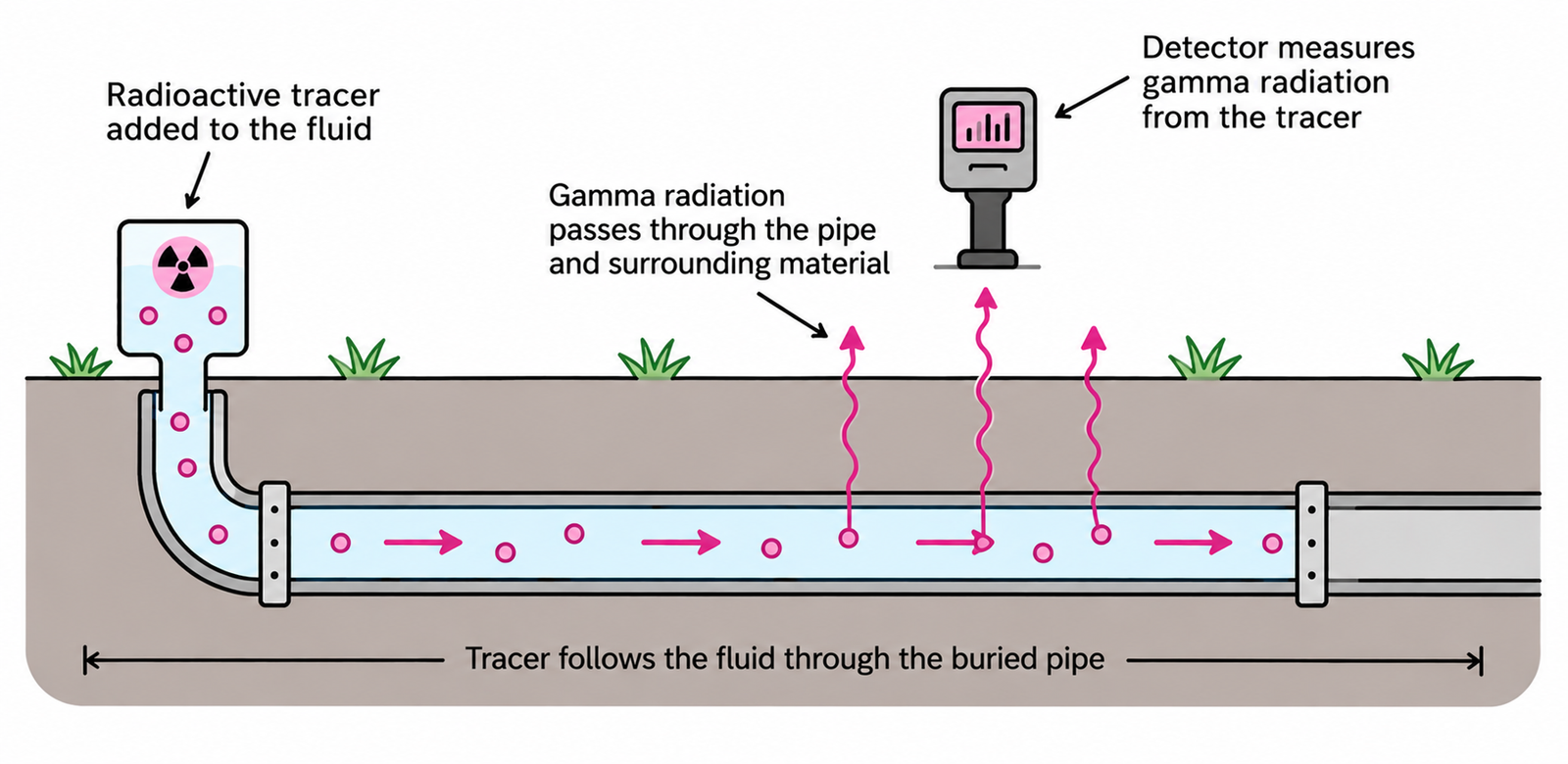
Where is the leak?
Move the detector between A, B, C and D. Compare the readings to find the likely leak. The detector measures gamma radiation emitted by the radioactive tracer — not the fluid itself. Background is 20 counts/s.
* Moving pink circles represent radioactive tracer carried by the flowing fluid. When revealed, pink circles above the pipe show tracer that has escaped into the surrounding ground. The pink wavy line represents gamma radiation. Readings are illustrative and include 20 counts/s background.
Choose a tracer that lasts long enough
A tracer must remain detectable during the investigation. A half-life much shorter than the journey or preparation time may let the activity fall too far before measurements are complete.
A very long half-life can leave radioactive material in the system unnecessarily long. Choose the chemical form, radiation type, half-life and activity together rather than treating one property as sufficient.
Which source fits a two-hour pipe investigation?
Assume all three tracers follow the fluid equally well and have suitable initial activities. The detector is outside a buried pipe. Choose the most suitable candidate from this simplified set.
| Candidate | Main emission | Half-life |
|---|---|---|
| P | Alpha | 6 h |
| Q | Gamma | 6 h |
| R | Gamma | 600 years |
Sterilizing medical equipment
Some medical equipment, such as disposable syringes, must be sterile before use. Gamma radiation can be used to sterilize suitable equipment while it remains inside its sealed packaging.
Gamma radiation penetrates the sealed packaging to sterilize the equipment.
A validated gamma irradiation process achieves a specified level of sterility by inactivating microorganisms. The packaging can then remain sealed, preventing recontamination before use.
* The radioactive source remains separate from the equipment. Gamma sterilization does not make the equipment radioactive. Real treatment takes place in a shielded facility with carefully controlled doses.
Food irradiation: reduce spoilage and harmful microbes
Food irradiation uses controlled ionising radiation to reduce harmful microorganisms, control pests and delay spoilage. It can extend shelf life, but it does not replace hygienic handling or suitable storage.
Food irradiation
A sealed source emits gamma radiation towards a sealed package of strawberries. Select Start treatment to see bacteria change from green to grey, one at a time.
Does gamma irradiation make the strawberries radioactive?
* The green rod-shaped bacteria are greatly enlarged. Grey bacteria with black crosses represent bacteria killed or unable to reproduce, not bacteria that have disappeared.Pink wavy lines represent gamma radiation, not radioactive material entering the food.
Food irradiation often aims to reduce microorganisms and extend shelf life. Medical sterilization uses a validated process to achieve a specified level of sterility.
Applying the calculations
Use the quantities provided to interpret an application. Detector readings are not automatically source activities.
Calculate corrected count rate:
A tracer detector records 260 counts/s. Background is 20 counts/s.
Corrected rate = total rate − background rate
Corrected rate = 260 − 20
Corrected rate = 240 counts/s
Calculate remaining activity:
A hypothetical tracer starts at 800 Bq with a 2 h half-life. Find its activity after 6 h.
Number of half-lives = time ÷ half-life
6 ÷ 2 = 3; 800 → 400 → 200 → 100
Activity = 100 Bq
Calculate count rate:
A thickness-gauge detector records 4200 counts in 30 s.
Count rate = counts ÷ counting time
Count rate = 4200 ÷ 30
Count rate = 140 counts/s
Benefits need controls
For each application, compare the benefit with the possible exposure and contamination routes. Use appropriate shielding, containment, remote handling and monitoring. Strong industrial sources need controlled facilities; a useful process is not an uncontrolled exposure.
Food irradiation and equipment sterilisation use radiation to damage microorganisms. Medicine can use radiation to image organs or target unwanted tissue. Those medical applications, including tracers, PET and radiotherapy, are explored in Chapter 10.
Check your understanding
Choose one answer for each question. Feedback appears underneath.
A factory suggests using alpha radiation to sterilise sealed packs and gamma radiation to monitor a very thin sheet. Explain why these choices may not suit the jobs, and suggest better matches.
Use penetration and absorption. Explain why the sheet’s thickness range matters.
Reveal the answer
Alpha particles are strongly absorbed and have a short range, so they would not penetrate the sealed package to treat microbes throughout its contents. Suitable gamma irradiation can reach inside the package.
For a very thin sheet, gamma radiation may mostly pass through, giving too little change in detector rate as thickness varies. A suitable beta source can be partly absorbed and provide a more sensitive thickness measurement.
The source energy and sheet material matter. Gamma can be useful for thicker materials, so the choice must be calibrated for the actual task rather than based on a universal rule.
CHAPTER 9
Chapter summary
- Ionisation smoke alarms use alpha radiation to create charge carriers; smoke reduces the current.
- A thickness gauge uses changes in transmission: thicker sheet, lower count rate; thinner sheet, higher rate.
- Radioactive tracers follow material through a system and can help locate leaks.
- Choose emission type, half-life, activity and chemical form to suit the task.
- Food irradiation can reduce harmful microbes and delay spoilage.
- Gamma irradiation can sterilise suitable equipment inside sealed packaging.
- Controlled irradiation does not mean radioactive material is added to the product.
- Benefits depend on appropriate exposure control and a source suited to the application.