
← Back to Atomic Structure contents
ATOMIC STRUCTURE · CHAPTER 12 OF 12
What powers the stars?
The Sun releases energy without burning fuel in oxygen. Deep in its core, light nuclei join. Why is this possible inside a star—and so difficult to use in a power station on Earth?
By the end, you’ll be able to…
- describe fusion as light nuclei joining to form a heavier nucleus
- explain energy release using a decrease in total rest mass
- explain the conditions needed for fusion and how they occur inside stars
- compare fusion with fission
- explain the scientific and engineering challenges of fusion electricity generation.
Fusion joins light nuclei
Nuclear fusion joins two light nuclei to form a heavier nucleus. Suitable reactions release energy because the products have less total rest mass than the reacting nuclei.
One important example for fusion research uses two hydrogen isotopes: deuterium, with one proton and one neutron, and tritium, with one proton and two neutrons. They can form a helium-4 nucleus and a neutron.
This deuterium–tritium reaction is a useful example for studying fusion, but it is not the main reaction sequence powering the Sun.
Where do the five nucleons go?
Follow the three stages. Count protons and neutrons before and after. The outgoing neutron is part of the products, not a missing particle.
* Compact particle diagrams, not to scale. Faint circles show approximate nuclear extent, not walls. Electrons are omitted. Animated repeats represent separate reactions. The model does not show every intermediate step.
Check what is conserved
Nucleon number
2 + 3 = 4 + 1
5 = 5
Charge
1 + 1 = 2 + 0
2 = 2
The mass numbers balance. That is different from saying the total rest mass in kilograms is exactly unchanged.
Why does fusion release energy?
When light nuclei fuse, the resulting particles can form a more tightly bound arrangement. Their combined rest mass is slightly lower than that of the starting nuclei.
The difference in rest mass corresponds to energy released, mainly as kinetic energy of the helium nucleus and neutron.
No protons or neutrons disappear. Total energy is conserved.
Why does fusion release energy?
Select After fusion to see how the combined rest mass changes when deuterium and tritium fuse.
* The scales are an analogy, and the mass difference is greatly exaggerated. No protons or neutrons disappear. The orange lightning represents released energy, mainly kinetic energy of the helium nucleus and neutron, rather than a separate burst of radiation.
Why don’t nuclei fuse easily at room temperature?
Both nuclei are positively charged, so electrostatic repulsion tends to push them apart. They must get extremely close for the strong nuclear interaction to bind them.
High temperature means particles have greater average kinetic energy, increasing the chance of sufficiently energetic encounters. High density makes encounters more frequent. The particles must also remain together for long enough: confinement time matters.
High pressure can help produce high density. The useful conditions are a combination of temperature, density and confinement—not simply “squeeze harder” or “make it hot”.
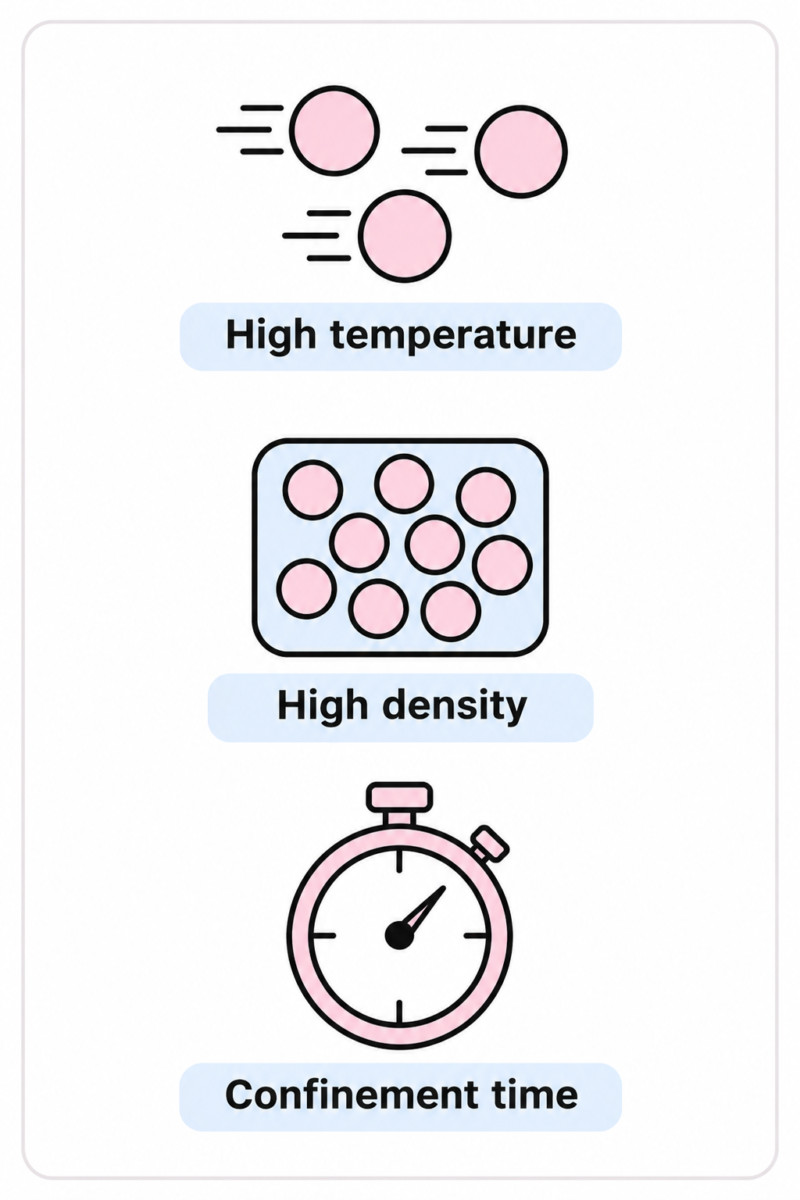
Temperature alone is not the whole story
Compare the three situations. The particle movements illustrate encounter conditions, not a measured fusion rate.
* Whole pink + symbols represent positive nuclei in plasma, not separate free protons in every case. Blue − symbols represent electrons. Particle numbers and spacing are schematic; the box is not a literal container suitable for touching hot plasma.
The Sun: gravity makes the conditions possible
The Sun is mostly hydrogen and helium. Its gravity compresses its interior, producing very high pressure and density. The core temperature is about 15 million °C. The Sun’s enormous mass provides gravitational confinement, allowing fusion to continue in its core over billions of years.
In the core, a sequence of nuclear reactions converts hydrogen into helium and releases energy. Hydrogen fusion powers the Sun and many other stars; other fusion processes occur in stars at different stages.
The Sun is not a chemical fire and does not need a supply of oxygen for fusion. Its main hydrogen-fusion sequence is different from the deuterium–tritium example used above.
Look inside the Sun
Select a feature to see how fusion, gravity and energy transfer are connected inside the Sun.
* Colours represent relative temperatures, not the Sun's actual colours. Pink particles represent protons; white particles represent neutrons. The gravity arrows show the direction of gravitational pull, not the Sun shrinking.
Fusion on Earth needs confinement
We cannot reproduce a star’s enormous gravitational confinement in a power station. One approach heats an ionised gas—a plasma—and uses magnetic fields to guide and confine its charged particles.
A tokamak holds plasma in a ring-shaped region. The plasma must be kept sufficiently hot while limiting contact with material walls, where it would lose energy. Magnets influence charged particles; they do not directly confine uncharged fusion neutrons.
Another approach uses powerful laser pulses to compress and heat a small fuel target for a very short time. Both approaches must achieve suitable temperature, density and confinement.
What do the magnets actually confine?
Compare charged plasma particles with an uncharged fusion neutron. This is a schematic ring view, not the detailed field geometry.
* Plasma shading is not a positive electrical charge filling the machine. Pink + particles are nuclei; blue − particles are electrons; white particles are neutrons. The wall, magnets and particle paths are not to scale.
Why is a practical power station difficult?
Producing fusion reactions is not the same as supplying net electricity to a grid. An experimental energy gain may compare fusion output with energy delivered to the fuel, while a power station must account for all its electrical inputs and conversion losses.
Deuterium is available in water, but tritium is radioactive and scarce. Deuterium–tritium systems must address fuel supply, potential neutron activation of materials and radioactive-material management. Fusion is not accurately described as “no radioactivity anywhere”.
Fission and fusion: compare the nuclear changes
| Feature | Fission | Fusion |
|---|---|---|
| Starting nuclei | A suitable heavy nucleus, such as U-235 | Suitable light nuclei, such as hydrogen isotopes |
| Main change | A nucleus splits into smaller nuclei | Nuclei join to form a heavier nucleus |
| Energy release | Products have lower total rest mass | Products have lower total rest mass in an energy-releasing reaction |
| Key conditions | Neutron availability and reactor control | Suitable temperature, density and confinement |
| Neutrons | Can continue a fission chain | Can be products, as in D–T fusion; this is not the same fission chain |
Which process is described?
Three worked examples
Use the supplied values. You do not need to memorise an energy per fusion reaction or calculate a mass defect for these questions.
Relate reaction number, energy and power:
Calculate energy released:
Given 2.8 × 10⁻¹² J per reaction, find the release from 5.0 × 10¹² reactions.
E = number of reactions × energy per reaction
E = (5.0 × 10¹²) × (2.8 × 10⁻¹²)
E = 14 J
Calculate power:
A hypothetical system releases 1.8 × 10⁹ J in 6 s.
P = E ÷ t
P = 1.8 × 10⁹ ÷ 6
P = 3.0 × 10⁸ W = 300 MW
Calculate conversion efficiency:
A hypothetical thermal system receives 500 MW and supplies 200 MW electrically.
Efficiency = useful output ÷ input × 100%
Efficiency = 200 ÷ 500 × 100%
Efficiency = 40%
Does output automatically mean net supply?
A hypothetical plant produces 200 MW of electricity. Its own equipment uses 150 MW. Compare gross output with net export.
Check your understanding
Choose one answer for each question. Feedback appears underneath.
“Fusion joins nuclei, so it should happen whenever hydrogen is squeezed together. A fusion energy gain of more than one proves a power station can export electricity.” Explain the errors.
Use electrostatic repulsion, temperature, density, confinement and the boundary used for an energy comparison.
Reveal the answer
Positive nuclei repel. Squeezing increases density, but a useful fusion rate also needs sufficiently energetic close encounters and appropriate confinement time. High temperature, density and confinement must work together.
A reported gain depends on which input is counted—for example energy delivered to the fuel. A power station must also cover heating-system losses, magnets, cooling, pumps and other facility demands, and convert released energy into electricity.
Useful net electrical export therefore requires a whole-system comparison. A positive result using a narrower experimental boundary does not by itself establish a practical or economic power station.
CHAPTER 12
Chapter summary
- Fusion joins light nuclei to form a heavier nucleus.
- D–T fusion produces helium-4 and a neutron, with five nucleons conserved.
- An energy-releasing fusion reaction has lower total product rest mass; the difference corresponds to released energy.
- Positive nuclei repel. High temperature, suitable density and confinement enable useful fusion rates.
- The Sun’s core supports hydrogen-fusion reactions; its main sequence is not the D–T example.
- Magnetic confinement acts on charged plasma particles, not uncharged neutrons.
- A fusion power system must manage energy losses, materials, fuel and whole-facility demand.
- Fission splits heavy nuclei; fusion joins light nuclei. Both can release nuclear energy.