
PARTICLE MODEL OF MATTER · CHAPTER 7 OF 10
Specific latent heat
Ice can keep absorbing energy as it melts without getting warmer. Boiling water can also receive energy while its temperature stays constant. How much energy is needed to change a substance’s state?
By the end, you’ll be able to…
- Describe how energy input, mass and material affect temperature rise.
- Define specific heat capacity and interpret its units.
- Use ΔE = m × c × ΔT to calculate energy transfers and temperature changes.
- Describe how to investigate specific heat capacity and explain the effect of energy losses.
Energy without a temperature rise
In Chapter 6, you calculated the energy needed to change a substance’s temperature. A change of state needs a different equation.
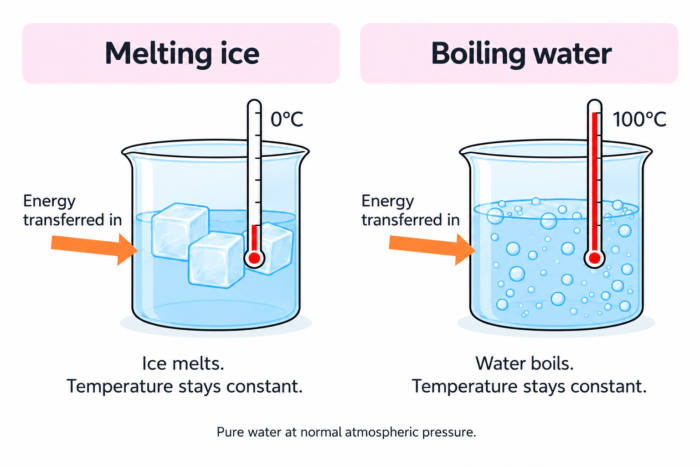
During melting or boiling of a pure substance at constant pressure, energy transferred in increases particle potential energy. Average particle kinetic energy—and therefore temperature—stays constant while the state changes.
The energy transferred during a change of state is called latent heat. “Latent” means hidden: energy is transferred even though a thermometer shows no temperature change.
What is specific latent heat?
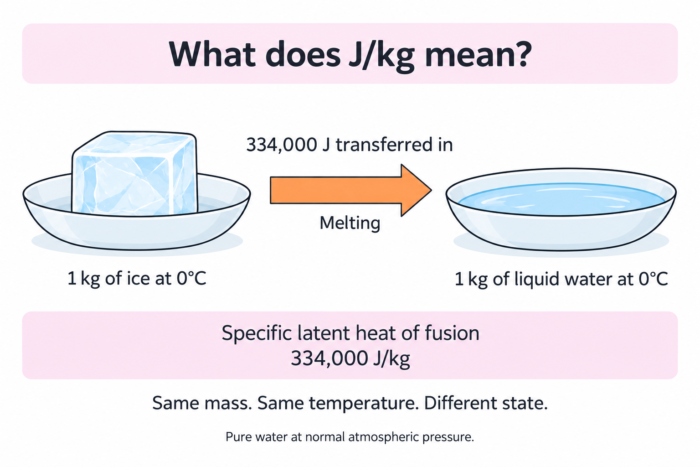
Specific latent heat is the energy required to change the state of 1kg of a substance without changing its temperature.
Its symbol is L and its unit is J/kg: joules per kilogram. Unlike the unit for specific heat capacity, there is no “per degree Celsius” because the temperature does not change during the process.
A higher specific latent heat means that more energy is needed to change the state of the same mass. The value depends on the substance and the change of state.
Fusion or vaporisation?
Fusion: solid ↔ liquid
Energy needed to melt 1kg at its melting point, without changing temperature.
Melting: energy transferred in.
Freezing: energy transferred out.
For water: 334,000 J/kg
Vaporisation: liquid ↔ gas
Energy needed to turn 1kg of liquid into gas at its boiling point, without changing temperature.
Boiling: energy transferred in.
Condensation: energy transferred out.
For water: 2,260,000 J/kg
Fusion and vaporisation: follow the particles
Compare particle arrangement and movement before and after each change of state.
Fusion: melting
Solid
Particles vibrate about fixed positions.
transferred in
Liquid
Particles stay close and move past one another.
Vaporisation: boiling
Liquid
Particles stay close and move past one another.
transferred in
Gas
Particles are widely separated and move randomly.
Simplified models of a generic substance; particle size and number stay the same. Movement and spacing are illustrative, not to scale.
*Water is unusual: its particles become more closely packed when ice melts. Real gas particles are much farther apart than the diagrams show.
Why does vaporising water need more energy than melting ice?
For water, the specific latent heat of fusion is approximately 334,000 J/kg, compared with 2,260,000 J/kg for vaporisation at normal atmospheric pressure. Vaporising the same mass therefore requires much more energy than melting it.
Same mass. Different change.
Both examples change the state of 0.10kg of water. Which change needs more energy: melting ice or boiling water?
Energy changes the ice into liquid water without raising its temperature. The mass stays the same.
water vapour
Vaporising the same mass of water needs about 6.8 times as much energy as melting the ice.
Pure water at normal atmospheric pressure. Energy values apply only to the change of state; energy losses are ignored. The animations are illustrative and do not compare heating times.
Calculating energy for a change of state
The equation
energy transferred = mass changing state × specific latent heat
E = m × L
E= Energy transferred for the change of state (J)
m=Mass that changes state (kg)
L=Specific latent heat (J/kg)
*Use the mass that actually changes state. If only 20g of a 100g ice sample melts, use 20g—not 100g.
Convert the mass to kilograms before calculating: 20g = 0.020kg. Use the specific latent heat value supplied in the question.
To calculate energy:
A drink contains 0.10kg of ice at 0°C.
Use L = 334,000 J/kg. Calculate the energy needed to melt all the ice at 0°C.
E = m × L
E = 0.10 × 334,000
E = 33,400J
To calculate mass:
Boiling water receives 113,000J for vaporisation. Use L = 2,260,000 J/kg. Calculate the mass that becomes water vapour.
m = E ÷ L
m = 113,000 ÷ 2,260,000
m = 0.050kg
To calculate specific latent heat:
A 0.20kg sample of a solid absorbs 40,000J as it melts at constant temperature. Calculate its specific latent heat of fusion.
L = E ÷ m
L = 40,000 ÷ 0.20
L = 200,000 J/kg
☆ You may also see Q = m × L; Q represents the energy transferred. There is no temperature-change factor in this equation.
What happens during freezing and condensation?
Reversing a change of state reverses the energy transfer. Freezing and condensation transfer energy out of the substance as particle potential energy decreases.
For the same substance, mass and conditions, freezing releases the same amount of energy that melting requires. Condensation releases the same amount that vaporisation requires.
For example, 0.10kg of water freezing at 0°C releases 33,400J. Its temperature stays at 0°C during freezing; it can fall further once freezing is complete.
Use E = m × L to calculate the amount of energy released as well as the amount absorbed.
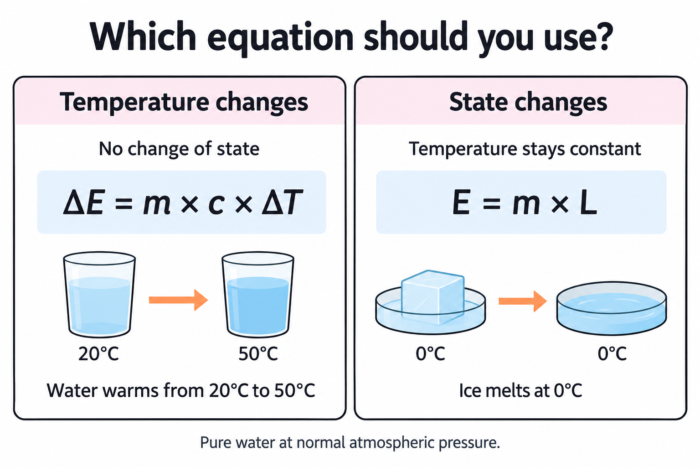
If ice starts below 0°C, energy is needed first to warm it to its melting point, then to melt it. Treat these as separate stages and add their energies. Further energy is needed if the resulting water also warms up.
Do not multiply E = m × L by temperature change. A zero temperature change during melting does not mean zero energy transfer.
Practical focus: measuring specific latent heat
We can estimate the specific latent heat of fusion by supplying measured energy to ice at its melting point and measuring the mass that melts. Using L = E ÷ m gives an estimate, but energy transfers involving the apparatus and surroundings must be considered.
Two ice packs contain the same mass of different materials, already at their melting points. Material A has twice the specific latent heat of fusion of material B. If both absorb energy at the same constant rate, which takes longer to melt completely—and why?
Material A takes twice as long to melt completely.
From E = m × L, equal masses with twice the specific latent heat require twice the energy to melt.
At the same constant rate of energy transfer, supplying twice the energy takes twice the time.
A material with a higher specific latent heat of fusion can absorb more energy per kilogram while melting, without its temperature rising.
Chapter summary
-
Specific latent heat is the energy needed to change the state
of 1kg of a substance without changing its temperature.
Its unit is J/kg. -
Specific latent heat of fusion describes melting.
Specific latent heat of vaporisation describes changing
liquid into gas. -
During melting or boiling of a pure substance at constant
pressure, energy increases particle potential energy.
Average kinetic energy and temperature stay constant. -
Use E = m × L to calculate energy transferred during a change
of state. Rearrange to m = E ÷ L or L = E ÷ m when needed. - Use the mass that actually changes state, measured in kilograms.
-
Freezing and condensation transfer energy out as particle
potential energy decreases. Reversing the change transfers
the same amount of energy in the opposite direction for
the same mass and conditions. -
For water, vaporising a given mass requires much more energy
than melting the same mass of ice. -
Use ΔE = m × c × ΔT for temperature changes without a change
of state, and E = m × L for changes of state at constant temperature.