
PARTICLE MODEL OF MATTER · CHAPTER 6 OF 10
Specific heat capacity
Heating a small amount of water takes less energy than heating a much larger amount through the same temperature rise. Different materials also need different amounts of energy. What determines how much energy a substance needs to warm up?
By the end, you’ll be able to…
- Describe how energy input, mass and material affect temperature rise.
- Define specific heat capacity and interpret its units.
- Use ΔE = m × c × ΔT to calculate energy transfers and temperature changes.
- Describe how to investigate specific heat capacity and explain the effect of energy losses.
What affects the temperature rise?
In Chapter 5, you saw that a temperature rise means an increase in the particles’ average kinetic energy. The size of that rise depends on the energy transferred into the substance, its mass and the material it is made from.
For the same mass and material, transferring more energy produces a larger temperature rise. For the same material and energy input, a larger mass has a smaller temperature rise. Different materials can also have different temperature rises for the same mass and energy input.
These comparisons assume that no change of state occurs and that the stated energy is transferred to the sample.
Same heating, different result?
Choose a comparison. Predict which sample will have the greater temperature rise, then select Play heating.
Energy values show the energy transferred into each sample during heating, not its total internal energy. Each sample already has internal energy at 20°C.
This idealised model ignores energy losses and energy absorbed by the apparatus, so energy transferred into the sample equals its increase in internal energy. No change of state occurs. Orange indicates active heating; it is not a real glow. The animation timescale and thermometer columns are illustrative.
Same heating, different result?
Choose what to compare. Watch how the temperature changes.
Both samples start at 20°C. Which will have the greater temperature rise?
Sample A · Water
Sample B · Water
Both samples start at 20°C and receive 63,000 J. Which will warm more?
Sample A · Water
Sample B · Water
Both samples start at 20°C and receive 36,000 J. Which will warm more?
Sample A · Aluminium
Sample B · Water
This simplified model assumes that all the energy transferred by heating goes into the sample, with no energy lost to the surroundings or absorbed by the apparatus. No change of state occurs. The thermometer movements and orange heating indicators are illustrative.
What is specific heat capacity?
Specific heat capacity is the energy required to raise the temperature of 1kg of a substance by 1°C, without changing its state.
Its symbol is c and its unit is J/kg°C: joules per kilogram per degree Celsius.
For example, water has a specific heat capacity of approximately 4200 J/kg°C. This means 4200J is needed to warm 1kg of water by 1°C.
A higher specific heat capacity means more energy is needed for the same mass and temperature rise. If equal masses receive equal energy inputs, the material with the higher specific heat capacity warms less.
Specific heat capacity is a property of the material. Doubling the mass doubles the energy needed for the same temperature rise, but leaves its specific heat capacity unchanged.
Why does the sea warm and cool slowly?
Water has a high specific heat capacity, so a large amount of energy is needed to change its temperature. This helps explain why the sea warms more slowly than the beach and retains summer warmth into early autumn.
Early summer
Warming gradually
A large mass of water warms gradually as it gains energy overall.
Early autumn
Cooling gradually
The sea retains warmth while gradually losing energy overall.
Water has a high specific heat capacity. A large mass of seawater needs a large energy transfer to warm up—and must transfer a large amount of energy out to cool down. It therefore warms and cools gradually, retaining energy absorbed during summer. This can keep the sea pleasantly warm for a beach holiday in early autumn.
* Energy enters and leaves the sea in both seasons. This is an illustrative seasonal comparison; sea temperatures vary with location, weather and currents. Sun rays and thermometer levels are illustrative. The thermometers show gradual changes, then reset.
Calculating energy transfers
The energy transferred to a substance during a temperature change is calculated using:
The equation
energy transferred = mass × specific heat capacity × temperature change
ΔE = m × c × ΔT
ΔE= change in thermal energy in joules (J)
m=mass in kilograms (kg)
c=specific heat capacity (J/kg°C)
ΔT=change in temperature (°C)
*This equation applies to a temperature change without a change of state. The energy needed for melting or boiling is explored in the next chapter.
To calculate energy:
ΔE = m × c × ΔT
A kettle heats 0.50 kg of water from 20°C to 60°C. Water has a specific heat capacity of 4200 J/kg°C. Calculate the energy transferred to the water.
ΔT = 60 − 20 = 40°C
ΔE = m × c × ΔT
ΔE = 0.50 × 4200 × 40
ΔE = 84,000 J
To calculate mass:
m = ΔE ÷ (c × ΔT)
Water in a hot-water bottle receives 25,200 J of energy as its temperature rises by 10°C. Water has a specific heat capacity of 4200 J/kg°C. Calculate its mass.
m = ΔE ÷ (c × ΔT)
m = 25,200 ÷ (4200 × 10)
m = 25,200 ÷ 42,000
m = 0.60 kg
To calculate specific heat capacity:
c = ΔE ÷ (m × ΔT)
A 1.0 kg metal block receives 9000 J of energy and its temperature rises by 10°C. Calculate its specific heat capacity.
c = ΔE ÷ (m × ΔT)
c = 9000 ÷ (1.0 × 10)
c = 9000 ÷ 10
c = 900 J/kg°C
To calculate temperature change:
ΔT = ΔE ÷ (m × c)
A 2.0 kg aluminium pan receives 9000 J of energy. Aluminium has a specific heat capacity of 900 J/kg°C. Calculate the pan’s temperature rise.
ΔT = ΔE ÷ (m × c)
ΔT = 9000 ÷ (2.0 × 900)
ΔT = 9000 ÷ 1800
ΔT = 5°C
* In these examples, the stated energy is transferred to the substance being heated. Energy losses to the surroundings are not included
Temperature change
The symbol Δ means “change in”. Temperature change can be written as ΔT or Δθ.
Water warming from 20°C to 35°C has a temperature rise of:
Use the temperature rise of 15°C in the equation.
Mass in kilograms
Convert grams to kilograms before using the equation.
For example:
Measuring specific heat capacity
You need to measure the sample’s mass, its temperature rise and the energy supplied during heating.
What do you need to measure?
Measure the water’s mass, the energy supplied during heating and its temperature rise.
The heater supplies energy; the thermometer measures temperature. The lid and insulation reduce energy transfer to the surroundings.
-
1
Measure the mass
Tare the balance with the empty container, then add water. Record its mass in kilograms.
-
2
Record the starting readings
Record the initial water temperature and energy-meter reading.
-
3
Heat and measure
Switch on the heater and stir gently. Switch it off, then record the final temperature and energy-meter reading.
-
4
Calculate the changes
Subtract initial from final readings to find the energy supplied and temperature rise.
-
5
Calculate specific heat capacity
c = ΔE ÷ (m × ΔT)
The energy meter measures energy supplied to the heater. Using this as the water’s energy gain assumes negligible energy transfer to the apparatus and surroundings. The next section explains the effect of these losses.
What about energy losses?
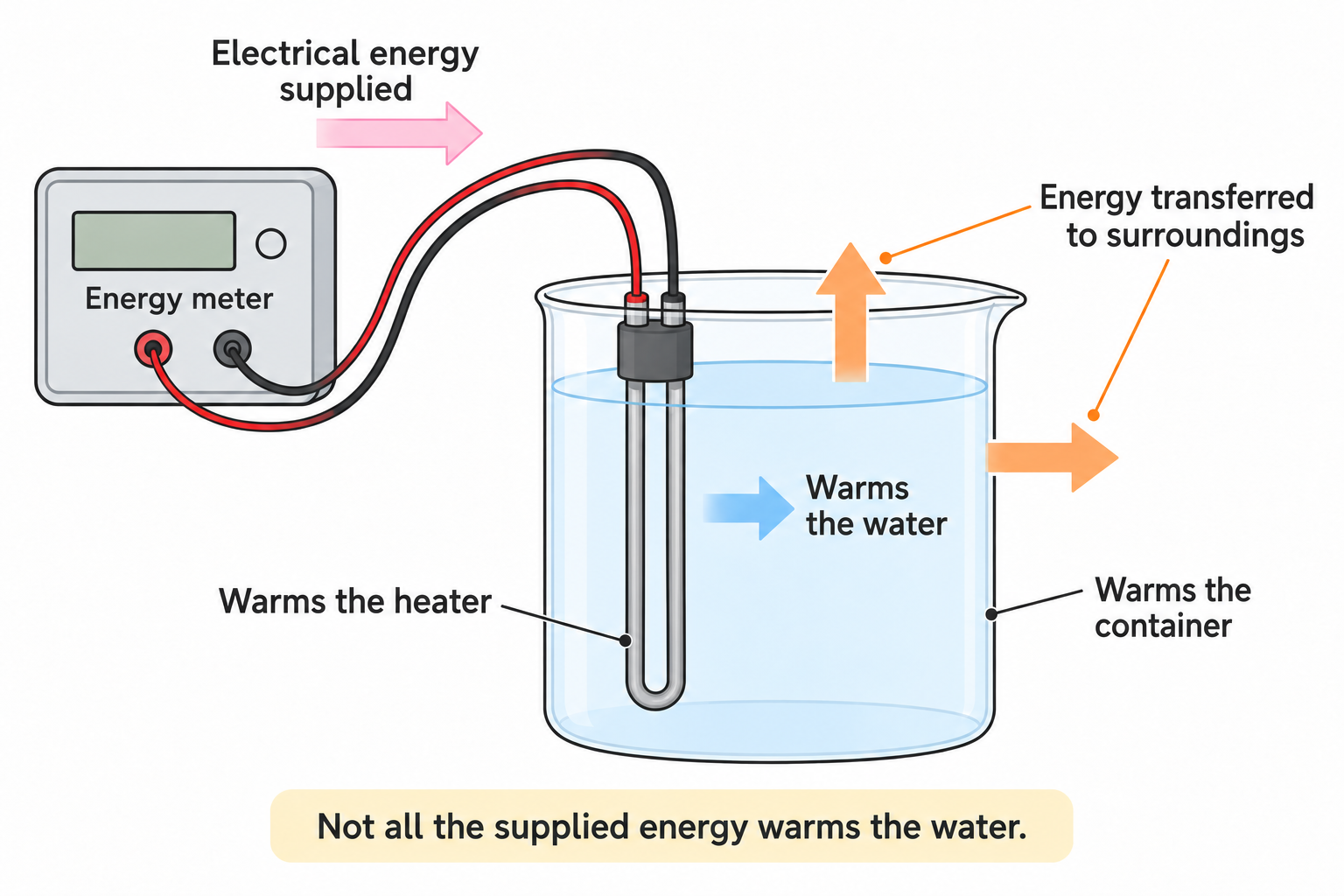
Not all the electrical energy supplied by the heater warms the sample. Some warms the heater and container, and some is transferred to the surroundings.
Why does this matter? If we assume all the supplied energy warms the sample, the calculated specific heat capacity will usually be too high, because the measured temperature rise is smaller than expected.
How can we improve the experiment?
Insulation and a lid
Reduce energy transfer to the surroundings.
Stir the water
Help make the temperature more uniform throughout the sample.
Good thermal contact
Improve energy transfer into a metal block.
Repeat measurements
Check consistency, but remember that repeating measurements does not remove systematic errors.
* Electrical energy supplied can be calculated using E = P × t, or E = V × I × t when potential difference and current remain approximately constant. Time must be measured in seconds.
A student calculates the specific heat capacity of water using all the electrical energy supplied by a heater. Some energy warmed the container and surroundings. Will the calculated value be too high or too low? Explain your answer.
The calculated value will be too high.
Not all the electrical energy supplied increases the water’s internal energy. Some warms the apparatus and some transfers to the surroundings during heating.
In c = ΔE ÷ (m × ΔT), the student therefore uses an energy value that is too large for the measured mass and temperature rise, giving a value of c that is too high.
Insulation and a lid reduce energy transfer to the surroundings.
Chapter summary
-
Specific heat capacity is the energy needed to raise the temperature
of 1kg of a substance by 1°C. Its unit is J/kg°C. -
Use ΔE = m × c × ΔT for a temperature change without a change of state.
Use mass in kilograms and energy in joules. -
Temperature change is final temperature minus initial temperature.
It may be written as ΔT or Δθ. -
For the same mass and material, transferring more energy produces
a greater temperature rise. -
For the same material and energy input, a larger mass has a smaller
temperature rise. -
A higher specific heat capacity means more energy is needed for
the same mass and temperature rise. -
The same equation applies to cooling: use the temperature fall
to calculate the amount of energy transferred out. -
Measure mass, energy supplied and temperature rise to investigate
specific heat capacity. -
Some supplied energy warms the apparatus or transfers to the
surroundings during heating. Using all the supplied energy as
the sample’s energy gain can make the calculated specific heat
capacity too high.
.