
ELECTRICITY · CHAPTER 4 OF 13
Electric charge
Brush dry hair with a plastic hairbrush and something surprising can happen: individual strands may become flyaway or stand apart. This happens because electrons have transferred, leaving the hair and brush electrically charged.
By the end, you’ll be able to…
- Identify the charges carried by protons and electrons.
- Describe how like and opposite charges interact.
- Explain how an object can become electrically charged.
There are two types of charge
Protons have positive charge and electrons have
negative charge. An object is neutral when
its total positive and negative charge balance. In electrostatic situations,
it is the electrons that transfer between objects—not the protons.
Proton
Positive charge
Remains fixed in the material
Electron
Negative charge
Can transfer between objects
How objects become charged
Most objects contain equal amounts of positive and negative charge, so they are neutral overall. However, rubbing two insulating materials together can cause electrons to transfer from one material to the other. This is called charging by friction.
Only the electrons move. The protons remain fixed inside the atoms of each material.
- The object that gains electrons becomes negatively charged.
- The object that loses electrons becomes positively charged.
The electrons are not created or destroyed—they are simply transferred from one object to the other. This means the two objects gain equal amounts of opposite charge.
How brushing hair creates static electricity
In this example, electrons move from the hair to the plastic brush. With other pairs of materials, electrons may transfer in the opposite direction.

Before brushing
The hair and brush are neutral. They contain equal amounts of positive and negative charge.
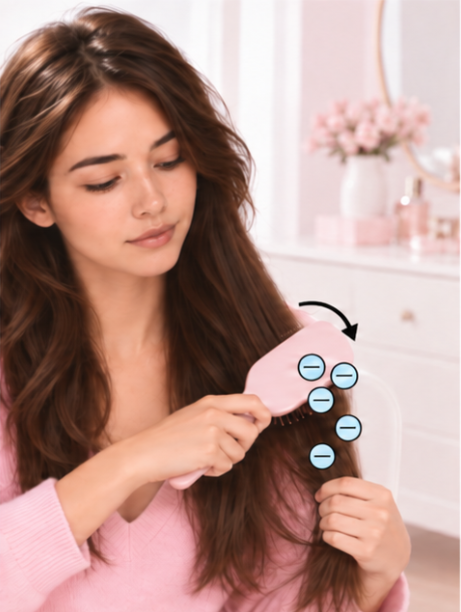
Electrons transfer
As the brush rubs against the hair, electrons move from the hair onto the brush.
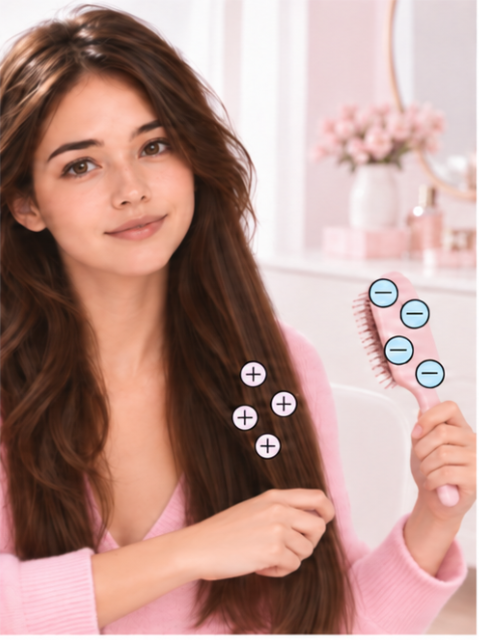
The objects become charged
The brush gains electrons and becomes negatively charged. The hair loses electrons and becomes positively charged.
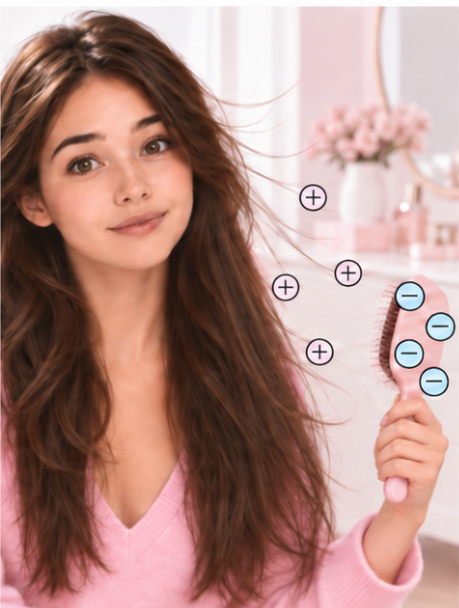
The charged hair moves
The positively charged strands repel one another, so they spread apart. They are also attracted towards the negatively charged brush.
*The charge symbols are not drawn to scale. Only electrons move between the hair and the brush; the positive particles remain within the material.
Move the electrons
Both objects begin neutral, with equal amounts of positive and negative charge. Move electrons between them to see how their overall charges change.
Object A
Object B
☆ Remember
Only electrons transfer between materials. Protons remain fixed inside atomic nuclei.
Rubbing does not create charge—it transfers electrons that were already present.
The rule to remember
Gain electrons: negative. Lose electrons: positive.
Gains electrons
More negative charge than positive charge → negative overall
Loses electrons
Less negative charge than positive charge → positive overall
☆Common misconception: nothing positive has been added
An object becomes positively charged because it has lost some negatively charged electrons—not because protons or positive charge have been transferred onto it.
How charged objects interact
Objects with opposite charges attract one another. Objects with the same type of charge repel one another. A charged object can also attract a nearby neutral object because the charges inside the neutral object become slightly rearranged.
Opposite charges attract
Like charges repel
Opposite charges attract. Like charges repel.
Check your understanding
Answer all three questions about charge, electron transfer and how charged objects interact.
Two neutral objects are rubbed together. Must they both end up charged?
No, not necessarily. If electrons transfer from one object to the other, both objects become charged: the object that loses electrons becomes positive, while the object that gains the same electrons becomes negative. Charge is transferred, not created. However, if no net transfer of electrons takes place, the objects remain neutral.
Chapter summary
- Protons have positive charge and electrons have negative charge.
- An object is neutral when its positive and negative charges balance.
- Only electrons transfer between objects; protons remain fixed within the material.
- When an object gains electrons, it becomes negatively charged.
- When an object loses electrons, it becomes positively charged.
- Like charges repel and opposite charges attract.
- Rubbing two insulating materials together can transfer electrons from one object to another. This is called charging by friction.