
ELECTRICITY · CHAPTER 3 OF 13
Conductors and insulators
Some materials let electric charge move through them easily. Others make it very difficult. What makes the difference?
By the end, you’ll be able to…
- Describe the difference between electrical conductors and insulators.
- Predict whether a material will allow electric charge to flow through it.
- Explain why metals are good electrical conductors.
Materials behave differently
Placing a material into the gap gives electric charge a possible route through the circuit.
If the lamp lights, charge is able to move through the material and the material is a conductor. If the lamp remains off, the material is an insulator.
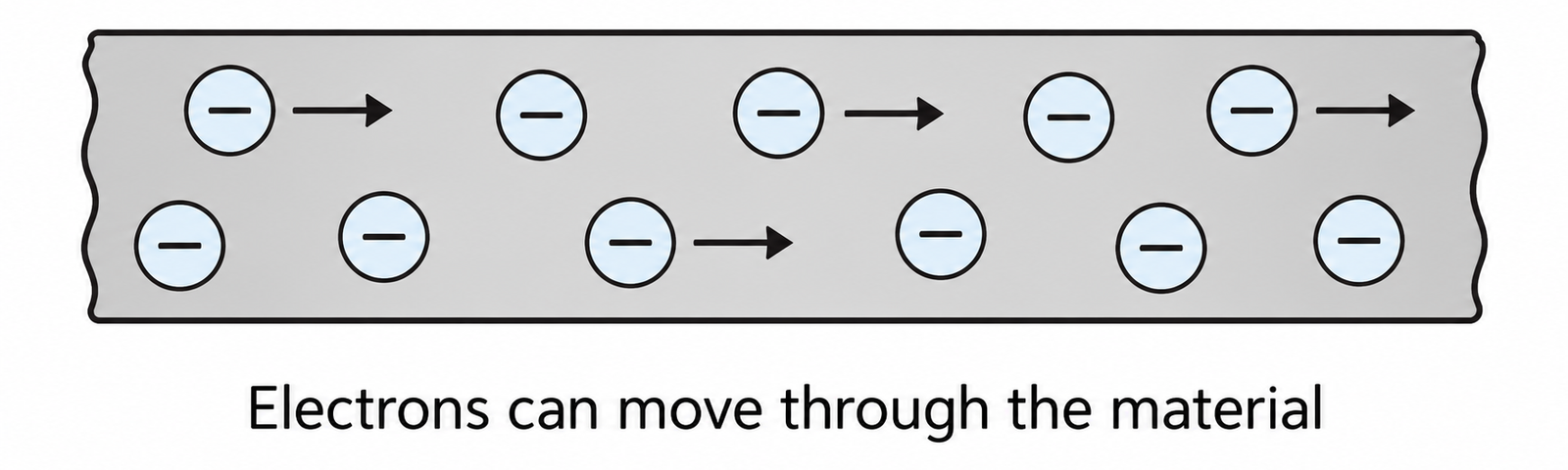
Conductor
A material through which electric charge can flow easily.
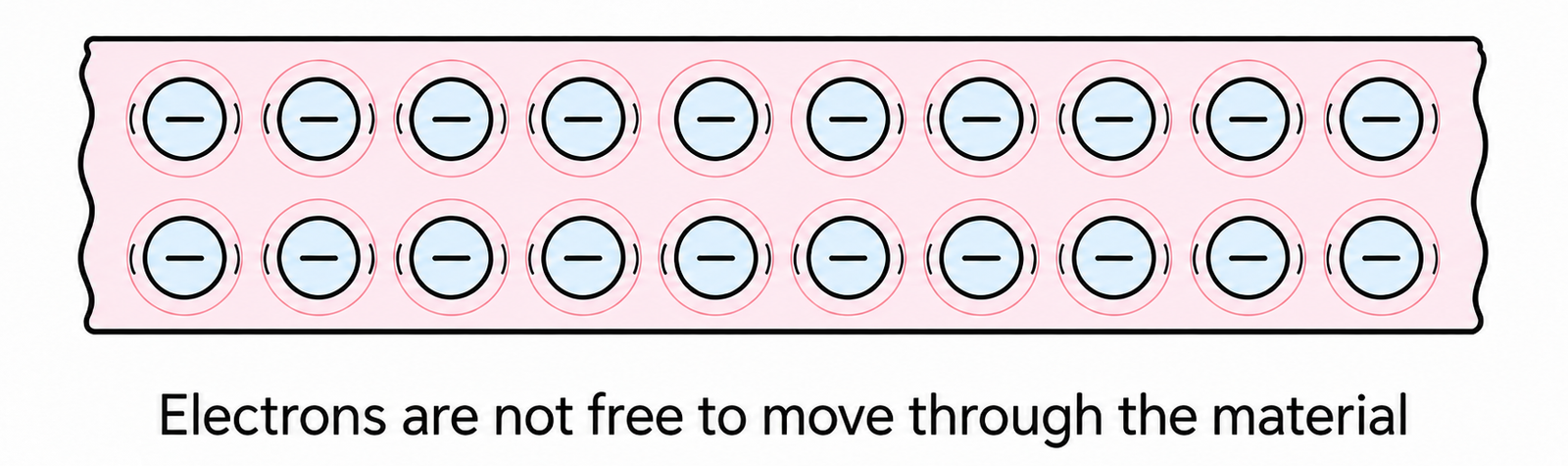
Insulator
A material through which electric charge cannot flow easily.
Which materials conduct?
Choose a material and test it in the circuit.
Steel is a metal. It contains electrons that are free to move and carry charge through the material.
Aluminium is a metal. It contains electrons that are free to move, so it completes the conducting path.
Graphite is not a metal, but it has electrons that can move. It is an important exception.
Rubber holds its electrons tightly and does not allow charge to flow easily.
Plastic is an electrical insulator, which is why it is useful around wires.
Dry wood is usually an insulator. Water and dissolved substances can change how materials behave.
What does this investigation show?
The steel paperclip and aluminium foil conduct because metals contain electrons that are free to move through the material.
Graphite also conducts, even though it is not a metal. Some of its electrons are able to move through its structure and carry charge.
Rubber, plastic and dry wood are insulators. Their electrons are not free to move through the material easily, so they do not complete the conducting path.
Why do metals conduct?
In a metal, some electrons are free to move through the material. When the metal forms part of a complete circuit, these electrons carry charge through it.
In most insulating materials, electrons are held more tightly and cannot move through the material easily.
Choosing materials for hair straighteners
One device needs several different materials
Hair straighteners contain both electrical conductors and insulators. Each material is selected because its properties make it suitable for a particular job.
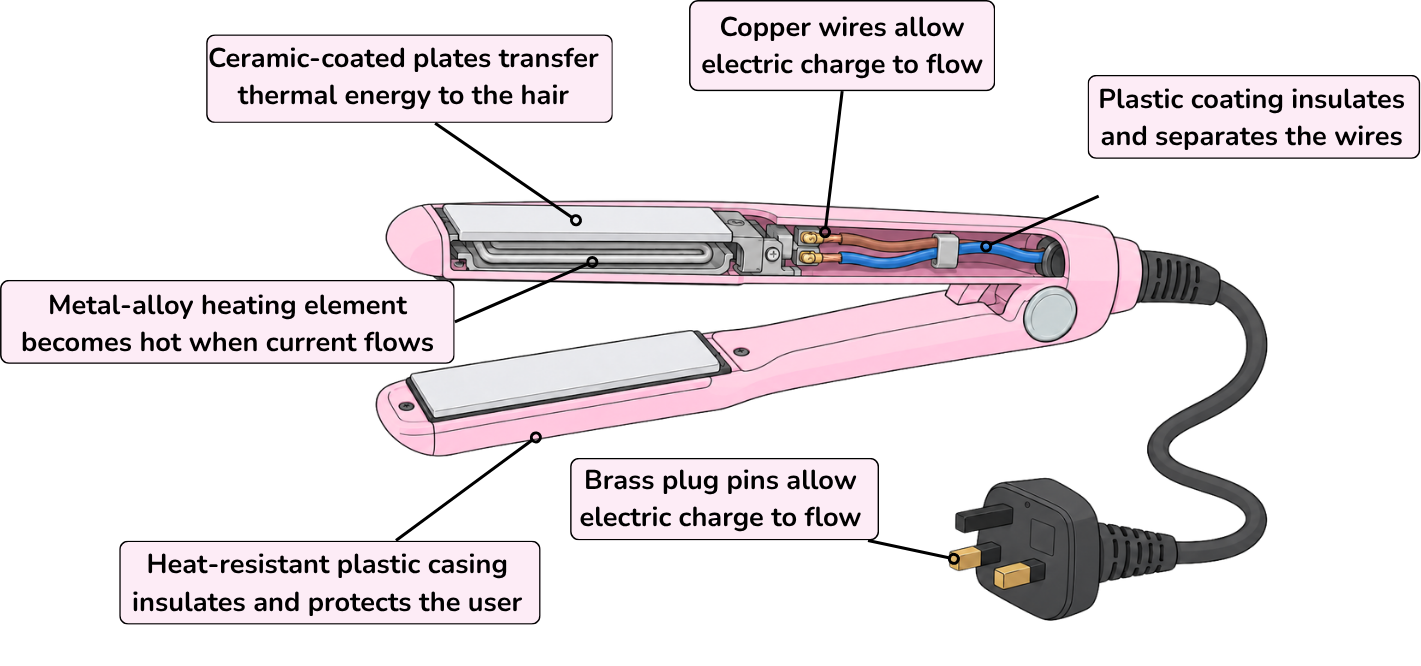
The copper wires and the two brass plug pins are conductors. They allow electric charge to flow through the appliance when it is connected to the mains supply.
Each copper wire is covered by plastic insulation. This prevents the conducting wires from touching each other or other parts of the appliance. The outer casing is also made from heat-resistant plastic. Because plastic is an electrical insulator, it helps separate the user from the conducting components inside.
The metal-alloy heating element becomes hot when current flows through it. It transfers energy by heating to the plates. The plates spread this thermal energy across the surface that touches the hair. Their ceramic coating creates a smooth, heat-resistant surface.
Hair straighteners therefore need materials with different properties: conductors where charge must flow and insulators where charge must not flow.
☆ Most metals conduct, but conductor does not simply mean metal. Graphite conducts too, and liquids containing dissolved ions can also conduct electricity.
Check your understanding
Choose an answer for each question.
Why can graphite conduct even though it is not a metal?
Graphite contains delocalised electrons. These electrons are free to move through its layered structure and carry electric charge, so graphite can conduct electricity even though it is not a metal.
CHAPTER 3
Chapter summary
- A conductor allows electric charge to flow through it easily.
- An insulator does not allow electric charge to flow through it easily.
- Metals are usually good conductors because they contain electrons that are free to move.
- Graphite is a non-metal that conducts electricity.
- Electrical devices often use conducting and insulating materials together.
- Plastic insulation around a wire helps prevent current from reaching someone who touches it.