
Feel confident in GCSE Physics
The maths you need for GCSE Physics—proportionality, ratios, rearranging formulae, units and graphs with clear explanations, worked examples and printable practice.
GCSE Physics can feel overwhelming, but it doesn’t need to. This page focuses on core physics understanding while strengthening the maths that supports it—proportionality, ratios, rearranging formulae, units and graphs—through clear explanations, step-by-step examples and printable practice.
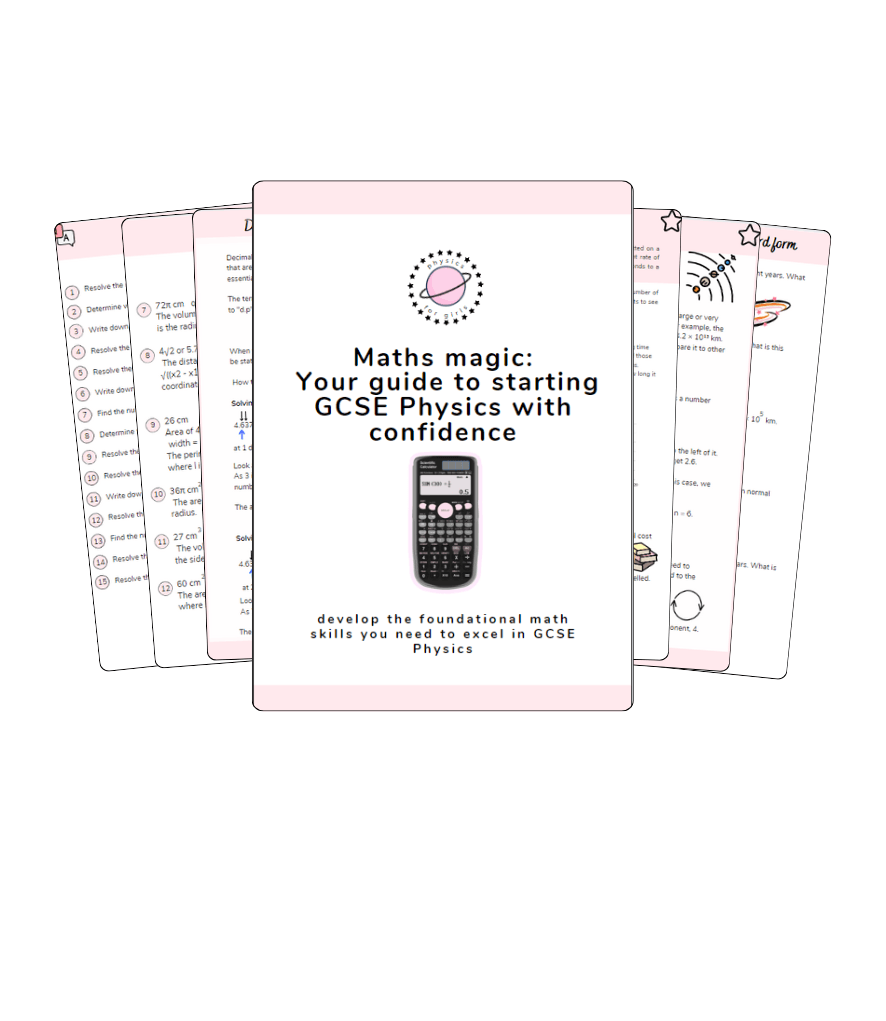
Maths Skills for GCSE Physics Printable workbook
Your guide to starting GCSE Physics with confidence by sharpening your maths skills!
Why GCSE Physics Comes First
Physics is the goal; maths is the toolkit. Learn the physics idea first, then use proportionality, ratios and rearranging formulae to apply it efficiently in questions and experiments. This approach keeps learning meaningful, speeds up calculations and reduces exam stress. When you understand what the physics is doing, the maths becomes a repeatable set of steps you can trust. Start with the concept, then choose the right relationship. Identify knowns and unknowns; pick or rearrange the formula. Check SI units and significant figures before calculating.
Proportionality and Ratios in GCSE Physics
Proportionality shows how changing one quantity affects another. In circuits, current is proportional to potential difference for a fixed resistance. In mechanics, acceleration is proportional to force and inversely proportional to mass. Writing these as simple ratio statements helps you predict changes quickly and avoid common mistakes. Spot direct versus inverse relationships. Convert worded statements into ratio statements such as “double V leads to double I”. Confirm proportionality with straight line graphs through the origin. Use ratios to estimate answers before you calculate. Quick example: if voltage doubles and resistance stays the same, current doubles. If force is constant but mass doubles, acceleration halves.
Rearranging Formulae for Faster Problem Solving
Many marks are lost during the rearranging step. Use a fixed method: write the formula, isolate the target variable symbolically, then substitute numbers with units. Always write the original formula first. Rearrange before substituting values. Keep units attached during substitution. Box your final answer with correct units and significant figures. Example: from F = m × a to a = F / m. If F = 20 N and m = 4 kg, then a = 5 m s⁻².
Units, Significant Figures and Scientific Notation
Consistent units make answers trustworthy. Work in SI units such as metre, kilogram, second, ampere, volt and joule. Use the significant figures requested in the question and standard form for very large or very small numbers. Convert kilometres to metres and minutes to seconds before you start. Keep extra digits in working and round only at the end. Use standard form, for example 2.4 × 10⁵ J, for clarity and accuracy. Example: a kettle rated at 2000 W running for 2 minutes uses E = P × t = 2000 × 120 = 2.4 × 10⁵ J.
Reading and Using Graphs
Graphs are a visual shortcut to marks when you know what to look for. On a distance–time graph, the slope gives speed. On a velocity–time graph, the slope gives acceleration and the area under the line gives distance travelled. Check axis labels and units first. Sketch the overall shape before plotting precisely. Link shapes to motion: a flat line on a velocity–time graph means constant velocity; a sloping line means acceleration. Use areas under velocity–time graphs to find distance. For a focused guide, see Mastering Physics Graphs: https://physicsforgirls.com/mastering-physics-graphs/
Practice That Builds Speed and Accuracy
Targeted practice turns methods into habits. Short, focused sets help you apply physics steps reliably and earn method marks even when the final value is slightly off. Try 10-minute drills on proportionality and ratios. Build rearranging practice with increasing complexity. Run quick checks on units, significant figures and standard form. Mix in graph questions to keep skills sharp.
Free Printable Workbook (optional support)
If you want extra practice on proportionality, ratios and rearranging, download the free printable workbook with step-by-step examples and self-mark questions. It supports — not replaces — your GCSE Physics learning and helps you move faster through calculations.
Worked Examples
Direct proportion in circuits: If V increases from 3 V to 6 V and R is constant, I doubles.
Inverse proportion in mechanics: With F fixed at 12 N, changing m from 2 kg to 3 kg reduces a from 6 m s⁻² to 4 m s⁻².
Rearranging pressure: p = F / A so A = F / p. Substitute with units, then round to required significant figures.
Quick Checks and Common Pitfalls
Mixed units such as kilometres with seconds cause errors — convert before calculating. Rearranging after substituting is risky — rearrange first. Rounding too early reduces accuracy — round only at the end. Misreading axes leads to wrong conclusions — read labels and units before interpreting. Missing units in the final answer loses marks — always include them.
Physics GCSE Success – The First Steps
Success in GCSE Physics starts with mastering the basics. Whether you’re struggling with rearranging formulas or want to sharpen your skills further, this guide is designed to meet you where you are and take you to the next level.
Stop letting maths hold you back and take control of your physics learning journey. Download the workbook today and discover how powerful the right tools can be in transforming your studies!
Where to Go Next
Explore forces, motion and practical examples in Why Understanding Forces in Physics Will Make You a Physics Pro: https://physicsforgirls.com/why-understanding-forces-will-make-you-a-physics-pro/ .
Why not try our quick Physics Quizzes to spot gaps and practise exam style questions.